Tuesday, 26 March 2013

Ghosts of the South Coast: Mount Gambier Gaol - Part 1


Ghosts of the South Coast

Old Mount Gambier Gaol

Part 1

In 2013, as part of our Honeymoon, my wife and I had the privilege of spending two nights in the Old Mount Gambier Gaol; and although nothing paranormal happened whilst we were present, there have been plenty of reported accounts of paranormal goings-on in the building in the recent past.

Border Watch,
 Tuesday 4 June 1946, page 14
What you are about to read below is taken from previous writings from my now-defunct Eidolon Paranormal website. The following is a brief account of the history and ghost stories. As I gather more information about the activities going on in the Gaol complex, I will post a more definitive review on the paranormal relationship of ghosts and guests, until then, enjoy this brief write-up.


History
The Old Mount Gambier Gaol was completed in 1866 after a need for a gaol in the southern regions of South Australia became an issue. 
The Gaol in Robe was insufficient and poorly built (only being open for ten years), and the Government at the time saw Mount Gambier as the next best location, and a more central place to build a gaol that would alleviate the issue of travel to Adelaide for inmates and Police officers.

The Gaol's first Keeper was George Tims.

A list of Keepers of Mount Gambier Gaol includes:

G.Tims – 1866
B. Young – 1884
D. Plunkett – 1888
S. Criddle – 1896.
R. McDonald – 1911
R. Lowe – 1917
E. Conole – 1920
H.E. Langlois – 1935
T. Lashbrook – 1960
A. Binnie – 1962
J Moody – 1963
G. Bullock – 1974
R.J Stratman – 1979 – until the Gaols closure in 1995

The Gaol has a long history of corporal punishment and hard labour, even unto children who were arrested and sentenced. One child, John MacMasters, a 13-year-old boy, was sentenced to Gaol for 18 months for forgery, where he would be inside with adult men, but to add more pain to his infliction, the judge also sentenced the boy to be flogged with 20 lashes in the last week of his stay at the gaol.
However, mercy was on the boy's side when the women of the local town heard of his plight and petitioned the Governor, who then spared the boy the flogging.

Where the ghost of a lady in
white is seen
Mary Turley was not so lucky, she was caught stealing and was on remand. Close to being imprisoned, her only saving grace, was her Father, who offered to give her a “severe whipping” for her crime. The judge allowed the Father's punishment and released the girl into his custody.

The Gaol saw death greet some of its prisoners. Suicide is the main account of death, usually by hanging. The first death by suicide was of an Aboriginal girl named Eliza Walton, on the 19th of January 1867.
Two executed men are thought
to be buried here
In the life span of the gaol operating years, from 1866 to 1995, twelve people lost their lives inside the walls of Old Mount Gambier Gaol, 2 men were hung for their crimes, 5 people committed suicide by hanging, and 4 people lost their lives through natural causes.

The first execution in Mount Gambier Gaol happened on November 10th, 1871. Carl Jung, a shoemaker and wine seller of German origin had gone into debt because of poor sales. In June that year, bailiff, Thomas Garroway was sent to seize the goods and effects of Jung.
The two men came to an agreement, and Jung was to follow the bailiff into Mount Gambier the following day. 
When morning broke and Jung joined Galloway to leave, the bailiff seized Jung's horse and cart, and some farm animals and set off for Mount Gambier.
 Jung was furious and set off after him. When he finally caught the bailiff, he shot him with both barrels of his shotgun at close range.

Jung tried to kill himself but was unsuccessful, and fled into the scrub to hide, but hunger overtook him and he returned to his home, where the police were waiting and apprehended him.
Jung was hung inside the Gaol, holding a bouquet of flowers, that he asked to be given to his wife upon his death.
Panorama of the cell blocks from the view of the Hanging Gallows

The next execution was that of William Page on the 27th of October 1875. Page was convicted for the brutal and gruesome strangling murder of Mary Buchan.
Page, also known as William Walker, had long deserted his wife and family and was wanted on desertion charges. He met Mary and courted her. He soon proposed (with a stolen ring), but kept delaying the wedding. Mary's parents urged her to end the relationship.
On Sunday 11th of July, 1875, Mary skipped Church to go for a walk with Page, her last walk on this Earth.

Her ending was pieced together by evidence given by Page, eyewitness accounts of Mary's whereabouts and Pathologist findings.
It is believed Mary went with Page, he pushed for sex, and Mary consented, but at the last minute refused, This angered Page, and an argument ensued, in which Mary returned the ring and refused marriage.

Page lost control and struck the girl with a whip with a metal tip on the end, Mary screamed uncontrollably from the pain, so Page grabbed her by the throat to quiet her, but killed her by doing so.
He buried her body and tried to hide the evidence of the crime, he then constructed an alibi, but he was already under suspicion, and when he tried to leave town were arrested.

Page pleaded guilty to his crimes of desertion, theft and murder and was duly sentenced and hung, at 8 am on the 27th of October 1875.


Next week we look into the final execution at the Gaol

© 2013 Allen Tiller


Tuesday, 19 March 2013

Freemason Grand Lodge - Sinister by Design Part IV


Sinister by Design: Part 4

Grand Freemason Lodge – Adelaide


Most people are well aware of the long-standing Freemason society that spans the western world.
 It is one of the longest-running "secret" societies in the world and has created a great deal of speculation over what it really does, purely by being so secretive over the past couple of centuries.


Today we are visiting another location designed by Adelaide’s own Freemason architect, John Queten Bruce.

Don't let the name of this blog series fool you, I am actually a very big fan of his work, and admire a lot of his designs, but to put it simply, there seems to be a connection of hauntings and mysteries surrounding the grand houses and buildings he designed.

Is there a link to his being a Freemason?

Did he knowingly add an element to his designs that would attract the supernatural to his buildings?

That's not something anyone but Mr Bruce and his associates will know for sure, but there does seem to be circumstantial evidence to persist in looking further into his work and designs and a supernatural, or paranormal connection.

The Freemason Grand Lodge is another of Bruce's designs in partnership with W. H. Harral who worked as a superintendent.

The land was first purchased in 1922 with the foundation stone, laid under with traditional Freemason ceremony, three years later.

In 1927, the lodge rooms on the third and fourth floor were dedicated.

It is a remarkable landmark on North Terrace with its four massive columns over the entranceway and the words “Audi Vide Tace”, Latin for “Hear, see, be silent, if you would live in peace” carved in a stone inscription above the door and a further inscription stating, “Erected and Dedicated to the Great Architect of the Universe AD 1925”

The Freemason's themselves run their own tour of the building every Thursday, which gives insights into the history, the symbolism and who some of Adelaide's most notable Freemason were as well as a ghost story or two!
There is also a small collection of memorabilia on display on the ground floor and a museum on the mezzanine level. 

You can hear, and see more of the Grand Lodge in Adelaide via this news story, where the ABC get an inside look into the building, and some insight into the spooky goings-on within.
http://www.abc.net.au/news/video/2009/06/22/2605121.htm?site=adelaide

© 2013 Allen Tiller

All content on “Eidolon Paranormal & The Haunts of Adelaide” site, blog and corresponding media pages (eg Facebook, twitter etc) is copyright. Apart from any fair dealing for the purpose of private study, research, criticism or review, as permitted under the Copyright Act, no part may be reproduced by any means or process without the written permission of the author. © 2012, 2013


All photos remain the property of their respective copyright owners and are displayed here for the purpose of education, research and review under the copyright act "fair usage" clause.

Some photos used here on this site are sourced from The State Library of South Australia, and The National Library of Australia and http://www.gawler.nowandthen.net.au - all photos are out of copyright and have no usage restrictions implied.

Tuesday, 12 March 2013

"Stonehenge" - Sinister by design Part 3


“Stonehenge” Robe Terrace Medindie


A quick trip back in time, we revisit our "Sinister by Design" series, which covered the architecture of John Quinton Bruce around Adelaide, first we looked at Carclew house, this time we visit the house he designed for Frederick Scarfe in North Adelaide.


The Mail, Saturday 11 October 1919, page 12
Designed by iconic South Australian architect; John Quinton Bruce for Fred Scarfe, A Director of South Australian department store icon, Harris Scarfes, Stonehenge, as the building was named, is a beautiful building located in North Adelaide.

Often it is reported that Frederick Norman Scarfe, former Mayor of Kensington and Norwood is the man who had the building erected, but by the time it was built, he was a very old man. Frederick George Alexander Scarfe is actually the man who built the impressive house, he was a director of Harris Scarfes at the time and a very wealthy individual.


Tony Syrianos - 
THE ADVERTISER NEWSPAPER 

ADELAIDE, April 24, 1994
The building consists of 15 main rooms including a gracious reception hallway and a sweeping grand staircase. There is also a Ballroom, a formal lounge-room, Library and formal dining room, plus 5 bedrooms and a wine cellar.

The house was often featured in local newspaper stories as Mr Scarfe would host his own events, Grand Balls and parties, in his home. In 1919 Frederick Scarfe sold the house for an impressive sum, citing in adds that he found the housekeeping tasks laborious, being such a large manner.

In 1994, The Adelaide Advertiser (April 24th 1994) published a story about the house featuring a local businessman who had purchased the house for $1.2 million dollars, only to find out that the house is haunted by a young lady.

The Register Thursday 13 November 1919

The young lady appears in an upstairs bedroom known as the Blue Room. It is stated that she only appears during the hours of 11 pm and 5 am and walks from the blue room, to a bathroom, or up the extravagant staircase. She is dressed in a white nightgown with an overly frilly neckline.
It is thought the spirit is that of a young girl who died in the house from tuberculosis around the 1920s, when the disease was making itself felt in North Adelaide.
It has also been reported that whenever renovations take place in the house, the ghost becomes very hostile and begins to throw objects and make a lot of noise, not unlike a poltergeist would do, other owners have also reported cold spots in various rooms of the mansion.

© 2013 Allen Tiller

All content on “Eidolon Paranormal & The Haunts of Adelaide” site, blog and corresponding media pages (eg Facebook, twitter etc) is copyright. Apart from any fair dealing for the purpose of private study, research, criticism or review, as permitted under the Copyright Act, no part may be reproduced by any means or process without the written permission of the author. © 2012, 2013


All photos remain the property of their respective copyright owners and are displayed here for the purpose of education, research and review under the copyright act "fair usage" clause.

Some photos used here on this site are sourced from The State Library of South Australia, and The National Library of Australia and http://www.gawler.nowandthen.net.au - all photos are out of copyright and have no usage restrictions implied.


Tuesday, 5 March 2013

The Murder of Mrs Martin: Ghosts of Gawler: Part 7


Ghosts of Gawler: The Murder of Mrs Martin


Tragedy struck Gawler on Wednesday the 24th of June 1925, when a 14-year-old Gawler High School student, a young man by the name of James Keats, shot and killed Mrs Martin, his boarding house owner, then killed himself.

Northern Times Carnarvon, WA, Friday 26 June 1925, page 3
The tragedy shook the then small country town and made news headlines right around Australia.
James Robert Keats was described as a normal boy with a tendency to over-study his school work.
Events that transpired that day came to light via witnesses prior to the event, and the only survivor, a little girl, the daughter of the victim, Ms Silvia Martin.

Earlier in the day Keats and another lad, one of the victim's sons, had set off to go to school sports. Keats got as far as the old cemetery (what is now known as Pioneer Park, across from Coles), and had to turn back as he had forgotten some books.
Bunyip Gawler, SA 1863 - 1954,
Friday 26 June 1925, page 2, 3
Keats at some point returned to the home, and wrote a small incomplete note, that read: “Dear Mum – Just a few lines to let you know I have found out...”

Either while writing, or very near after writing, Keats took his Boy Scout knife and stabbed Mrs Martin so viciously he broke some of her ribs, Keats then struck Mrs Martins daughter, Silvia with the butt of a rifle he had taken from the wardrobe of Mr Martin.
He threw a coat over the girls head at some point and struck her again. The coat, according to the girl's testimony, then lifted enough for her to see Keats lift the rifle, point it at his own chest, and shoot, killing him.
The young girl then ran into the street seeking help, which she found with a nearby neighbour.

Border Watch Mount Gambier,
Friday 26 June 1925, page 3
The case hit the courts and the headlines, with a number of interesting theories as to why the boy, who left no clues, and had no motive, would kill Mrs Martin, then himself. 
One of the more “interesting” theories came from long-standing Gawler Lawyer, Mr Rudall who’s theory was the boy had “over-studied” therefore creating a temporary “brain-storm” of derangement that led to the murder-suicide.
The case was never concluded satisfactorily, and still remains a mystery as to why Keats did what he did, the Coroner put Keats actions down as “ A loss of reason” on the part of the boy...

Will we ever know what truly happened on that fateful afternoon in Gawler?

© 2013 Allen Tiller
www.eidolonparanormal.com.au


Tuesday, 26 February 2013

Para-Para: Ghosts of Gawler: Part 6


The Ghosts of Gawler Part 6

Para-Para


Para-Para Mansion, an icon of Gawler, situated in what is now Gawler West. 
Having grown up very nearby, it wasn't unusual for myself and my friends to wander onto the Para-Para estate as boys, walking along the river, we would find ourselves in the backyard of the mansion's property on occasion and marvel at all the farm equipment strewn about the place.
Of course, having grown up in Gawler, and going to school nearby, I inevitably heard the rumours of the Mansion being haunted. 
There were a great many stories to tell, most coming from when the building was unoccupied for many, many years, my favourite one isn't so much a ghost story but a practical joke of sorts, that could well have been an urban legend, it went something like this.

A group of older school boys led some younger schoolboys to the mansion to tell them some ghost stories, and generally spook the younger lads. They peeked through windows at the somewhat derelict insides, room by room, telling the boys stories of murders and suicides, when they got to the last room, the younger boys would freak out and run away...of course the older boys would fall on the ground in hysterics, because much earlier they had broken in and nailed all the furniture to the roof, making it seem, in the gloom of the evening, as though the furniture was floating up there!

Two other ghost stories I can remember, one involves a young lady committing suicide. She had fallen for a young man but had found him sleeping with the Mansions maid, she flung herself down the staircase and broke her neck. It was always rumoured that if you peeked through the glass of the door you would see her white face peek back.

The other notable story from my childhood involved a man of the house, who was someone of importance, being found by his wife having sex with the housekeeper in front of an open fireplace on the bottom floor.
 In her shock she grabbed a fire poker and stabbed him through the back with it, killing him, she then hit the maid over the head with a wooden rolling pin, killing her, then pushed them both into the fire...she then threw herself down the stairs and broke her neck landing on the floor...

So were any of these stories true?

Most likely not, the only death recorded in the house in local newspapers was that of the original builder and owner Mr Walter Duffield, who died on November 5th 1882. It is most likely that the stories sprung from periods when the house was empty and local kids would find their way in, however, saying that, in 1939, The Bunyip, Gawler's local newspaper ran an article that mentions the rumour of a ghost "floating up and down the staircase”.
Another article, an extract of which is published here also mentions a lady on the staircase.
Para Para in 2012 - photo by K. Tiller

Other than it's infamous ghost stories and urban legends, Para Para also has a royal connection, with His Royal Highness, Prince Alfred, Duke of Edinburgh, staying at Para Para in 1867.


Plenty has been said about the history of Para Para, and rather than rehash what is already written, those of you who want to learn, or discover more are welcome to follow the link provided below.
http://www.hosking.wattle.id.au/~laurel/parahtml/parahistory.html


Para Para is now a private residence and should be treated as such. The legends of it being haunted, are just that, legends which seem to be attached to any old large house anywhere in the world.
If you wish to view Para Para, please do so from the road and DO NOT trespass as it is private property.


© 2013 Allen Tiller

Tuesday, 19 February 2013

Pioneer Park: The Ghosts of Gawler: Part Five


The Ghosts of Gawler Part Five:
Pioneer Park 

At the northern end of Gawler's main street, across the road from the Coles complex, is a very pretty park featuring a rotunda and a memorial garden, it is bordered on one side by a shed owned by the Exchange Hotel and the Gawler Tourist Centre.

The "Old Cemetery"
The park has been a meeting place for Gawlerites for decades, being used annually for local events, outings and picnics.
Having grown up in Gawler, I know the park and the stories associated it with very well. I can remember when a canon used to stand on the north-west facade and was fired during an annual street party, I remember all the youth of the town meeting on the hill during weekends, because there really wasn't much else to do in the town, most of those kids were totally unaware of the bodies buried beneath their feet, but not me, I knew better.

The cemetery was first established when the town plan was drawn by Colonel Light, it is not entirely clear who the first person buried was, but by 1870, the cemetery was closed except for those who had already bought a plot to buried in.
The cemetery sat at the top of the street, pretty much unused, as the bigger Willaston public cemetery had been opened and was being used, as well as the Anglican cemetery in Gawler East and the Loos cemetery in what is now Buchefelde.

It wasn't until the late 1920s that someone decided something should be done with the now decrepit cemetery who's headstones were cracked and falling over, whose fences were broken and unpainted, the “old cemetery” as it was now referred to, was in a state of very bad disrepair.
A Rotunda on the park in 1914


The first idea to clean the place up came in 1925, but it took ten more years before anything was actually done by the councillors.

Work began, the fences were removed, the headstones were taken down (and now sit inside the front gates of the Willaston cemetery), land was levelled, trees planted, garden beds were laid, and a rotunda was built, the name was changed from the much-used “Old Cemetery” to “Pioneer Place” and Gawler's most used green square was born.
Now one would not know a cemetery stood there, other than the large monument on the western side dedicated to John McKinlay, which had to be rebuilt due to a semi-trailer demolishing one side of it. The other clue to a cemetery once being here is the memorial stones with lists of names in the centre of the gardens.

 In the late 1990sa worker was in the shed of the Exchange Hotel next to the park, when two coffins slid through the cracked and broken wall into the shed from the old cemetery, you can imagine the gossip this caused in the town!
The McKinlay monument after being hit by a truck
I have heard many ghost stories associated with the place over the years, even back in the day when it was a cemetery there were stories, one of which was a sighting of Spring-heeled Stephen, but mostly they were the typical ghost stories, ladies with lamps, gentlemen standing in the shadows etc.
One of the more recent stories I have heard is a man in an older styled suit standing looking out towards the Coles complex, who simply disappears. I am sure there are many more stories that I am yet to hear, and I invite you to share them in the comments section below


© 2013 Allen Tiller

Tuesday, 12 February 2013

The Bunyip: The Ghosts of Gawler Part Four


The Bunyip

The Ghosts of Gawler Part Four


  The Bunyip Newspaper began its existence in 1863 as a monthly pamphlet published in collaboration with  "The Humbug Society". Editor Dr George Nott and printer, William Barnet teamed together to create what was to become South Australia's longest-running family-owned newspaper.

When the paper began, it was a satirical look at life around Gawler. Later, it was to become a weekly "orthodox" newspaper, still with a strong community focus, but expanding into further suburbs and country areas surrounding Gawler.

 The Bunyip Newspaper, in its early life, was situated in a shop near the Baptist Church in Murray Street, Gawler. Later its offices were moved further along Murray Street to be situated near the Prince Albert Hotel. Those premises were destroyed by a fire and 'The Bunyip' relocated to its present location, of which it has remained in since 1885.

The Bunyip Newspaper was sold to the "Taylor Group" of newspapers in 2003 by the Barnet family, ending the families long ownership of this local icon (September 1863 until April 2003).

The haunted staircase
Since the sale, The Bunyip has seen many changes in formatting, design and presentation, including the adding of colour to its format. The Bunyip continues to be one of Gawler's most respected icons and sources of news and entertainment, The Bunyip contributes to a great many of the events of the town, with sponsorship and support and continues to be the best resource for local news and events.

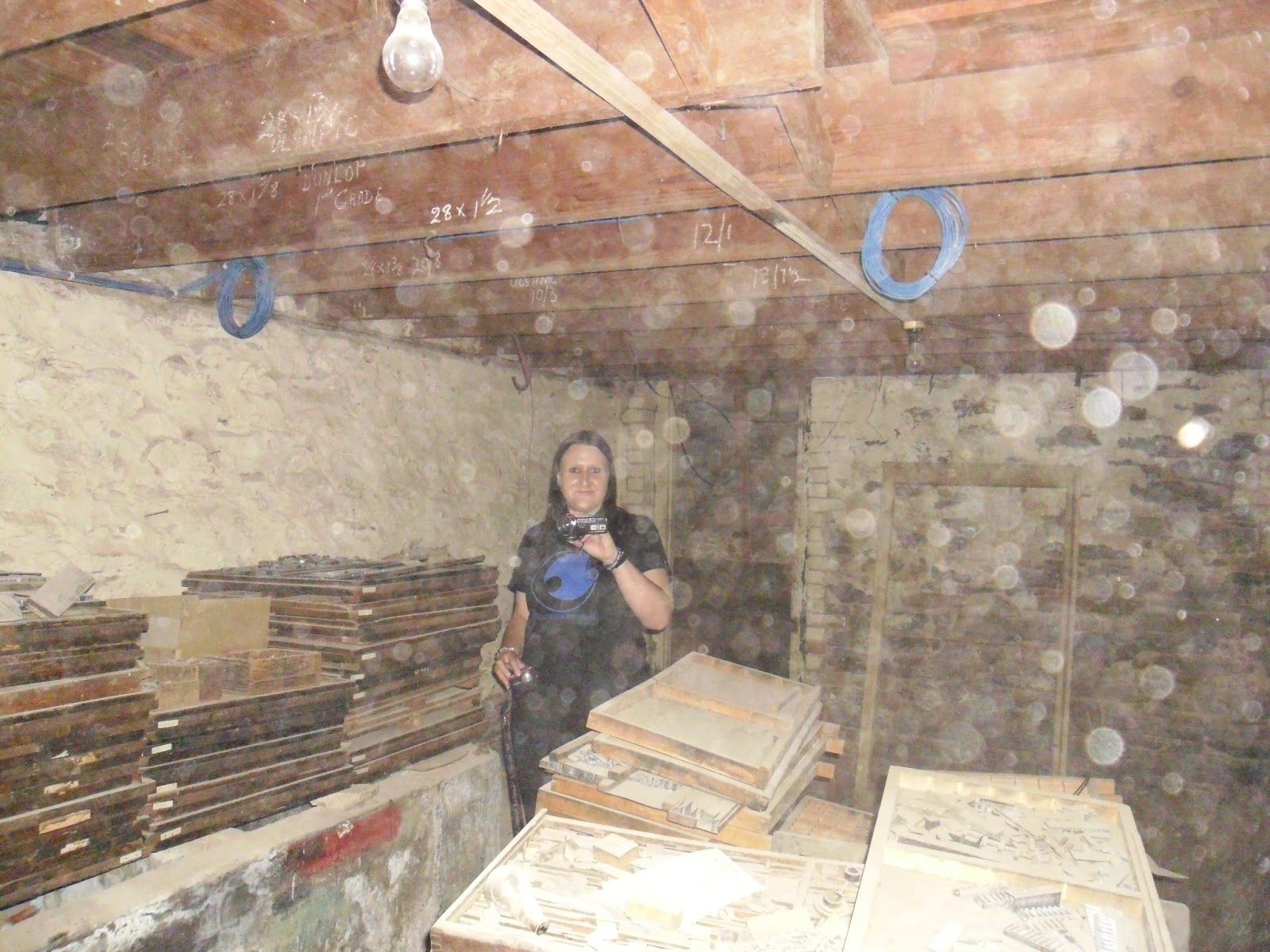
Karen and I were lucky enough to be invited by the newspaper's General Manager, Margaret, to investigate the Bunyip office and printing area. We had a tour of the location including the cellar, which still contained a lot of the old printing tools from the beginning of the 1900s. We also found another room adjacent to the basement that had long been sealed off, no doorways were visible into the room from the old hole in the wall through which we were looking, so we do not know exactly what the rooms use may have once been.

Karen in the Basement
The majority of the phenomena reported to us seemed to be taking place upstairs in the offices. We headed upstairs and started recorded a number of EVP's, with questions tailored to the research we had previously undertaken.
 We heard a couple of loud knocks during our EVP session, but they did not appear on the audio recordings, in their place, however, was low pitch sounds of a dog barking, which no-one in the room with us heard at the time.

The other allegedly active area was a downstairs office, where chairs had moved by their own volition and the sounds of someone sitting at a desk writing had been heard by numerous witnesses. This was intriguing, but on this occasion, we didn’t manage to capture anything on video or audio we would deem as paranormal in origin.

Perhaps the most intriguing alleged paranormal phenomena were the sounds of someone walking up and down the staircase in the centre of the building. Witnesses to this phenomena went to inspect who else was inside the building with them only to find the place securely locked down, and no one else inside!
  Through rigorous debunking, we ruled out the expansion and settling of the wood of the staircase and that of the building. We conducted a number of experiments to try and recreate the reported sounds, with no success. It would seem the person (or Ghost) that is responsible for the noise has some large heavy boots and really wants to be heard, but not seen!


© 2013 Allen Tiller