Showing posts with label The Bunyip. Show all posts

Wednesday, 6 December 2023

The Bunyip Boys


The Bunyip Boys 1.

First published on the ‘Gawler: Colonial Athens’ blog on 2/10/2021


 The Bunyip Boys was drawn by American cartoonist Gene Byrnes (March 18, 1889 – July 26, 1974). In the US, and in some Australian reprints the comic was known as 'Reg'lar Fellas'.  It has also been published under the name ' The Children's Corner'.

It is only called ' The Bunyip Boys' in The Bunyip newspaper, published in Gawler, South Australia.

Saturday, 2 December 2023

Thomas ‘Tommy’ Kendall – Gawler Town Crier


Thomas ‘Tommy’ Kendall – Gawler Town Crier

First published on the 'Gawler: Colonial Athens' blog on 2/2/2021

Thomas ‘Tommy’ Kendall was one of Gawler’s early Town Criers. He came to South Australia on board the barque Kingston on 18 December 1848, arriving at Port Adelaide from Sydney. He travelled with his wife Catherine.[1]

Thomas had previously been a Private in the 80th Regiment of Foot, based at Chatham Kent.


Thomas Kendall's grave, West Tce. Cemetery
Source: Dwight Baker - Find a Grave 2016

The Bunyip wrote the following about a Town Crier named Kendall in 1879 under an article titled ‘Sayings and Doings Colonial Athens’:

BILL STICKING AND TOWN CRYING.

So we are to have a new bill poster and town cryer in Gawler. That's a sign of progress I think, and he's sure to get large patronage.

His name is Kendall, and I wouldn't wonder if he don't 'kindle' some enthusiasm in the hearts of the people here. Why do town cryers always use bells? This is an age of novelty, and I would suggest a drum as a better style of announcing sales and entertainments. The beating of a drum would stir all hearts with the enlivening sound; even yet I fondly remember how in childhood I often listened to the drummer, as he twirled his stick with rub a dub, 'dow-de-dow,'

Therefore my advice to, the new cryer is to introduce the drum, and beat up a hearty 'row-dow-dow' whenever a sale is on.[2]

Thomas suffered an elbow injury while working as an ostler at the Mill Inn in 1881.


Accident.—A serious accident happened on Tuesday morning at the Mill Inn, Gawler, to Mr. Thomas Kendall. It appears that Kendall although warned against doing so, went into the stable and began to clean a horse belonging to Mr. Denton, of Morgan, when the horse, which is generally quiet, kicked Kendall in the right elbow, putting it out of joint Mr. Popham was immediately in attendance, and set the fractured limb.[3]


Thomas died at the Adelaide Destitute Asylum on 25 July 1883. He was 73 years old.[4]


Upon his death, The Bunyip newspaper published the following epitaph regarding Tommy’s death, buried deep within another article:

On Monday a Gawler celebrity took his departure for that bourne from whence no man returneth. Thomas Kendall, or "Tommy," as he was more generally known by, died in the Adelaide Hospital from general decay. For some years past he has been the favorite town crier and bill sticker, and well has he done his work. He lived in poor circumstances, and although there were many who would have helped him, his independent spirit kept him from taking their aid, as he preferred to be free of obligation to any one.[5]


Also printed in the Bunyip was this epitaph in 1883. The excerpt from an article is written in the exact language used below, mocking the poor and uneducated. Perhaps this was an attempt at humour.?

Mrs. Harris On Things In General, Gawler Things in Particular

A few days ago, poor old Tommy Kendall took his larst journey for a distant shore, where I trust neither bill-sticking nor crying will be required of him.

The old gentleman was not a bad sort, full of informashun bought and paid for, possessing many good traits of character ,and your Betsey espeshily kan testify to his honesty, independent spirit, and an earnest desire to act squarely. I think those are very good traits in a man an nis poverty ort not to be a barrier for honorable menshun. May he have better times of it than he have had lately are the earnest wish of

Yours trooly,

Betsy Harris.[6]


Researched and written by Allen Tiller © 2021.

Photo: Dwight Baker (contributor 47306645), Find a Grave, database and images memorial page for Thomas Kendall (unknown–26 Jul 1883), Find a Grave Memorial no. 159724849, citing West Terrace Cemetery, Adelaide, Adelaide City, South Australia, Australia ; 

[1] 'SHIPPING INTELLIGENCE.', South Australian, (22 December 1848), p. 2.
[2] 'SAYINGS AND DOINGS COLONIAL ATHENS.', Bunyip (21 February 1879), p. 4.
[3] 'GENERAL NEWS.', Adelaide Observer, (8 October 1881), p. 31.
[4] Thomas Kendall, Australia, Death Index, 1787-1985, vol. 129, p, 407
[5] 'TAXATION.', Bunyip, (3 August 1883), p. 2.
[6] 'MRS. HARRIS ON THINGS IN GENERAL, GAWLER THINGS IN PARTICULAR.', Bunyip, (10 August 1883), p. 3

Wednesday, 22 November 2023

Gawler before, and its First Building.

 Gawler before, and its First Building.


Documentary evidence reveals that Gawler came under the foot of the white man in 1837 when a survey party to the Barossa hills found a wanderer in the scrub. Being ill, they put him on the bullock dray. Reaching the ford over the South Para River, they found him dead, and so they buried him in a hollow tree, decently covering the body with bark and sticks.  They called the ford Dead Man's Pass, and the place to this day retains the name.

Gawler’s first building was the Old Spot Inn, built by Mr. Schiebner. By the end of 1839 the traffic from the River Murray and the North was so great that Mr. King had to give up entertaining, so he induced Mr. Schiebner to build and provided the money for the building. Soon after that time, there was a small dairy station up the South Para River, belonging to Captain Walker, and Messrs Grant and Butler (grandfather of the State's ex-Premier) had a sheep station at Yattalunga.


'Gawler before, and its First Building.', Bunyip, (3 February 1939), p. 9., http://nla.gov.au/nla.news-article96704537

Tuesday, 21 August 2018

"Gawler" by La Journie, 1930


"Gawler" by La Journie, 1930
SLSA: B 11491 Gawler Railway Station opened in 1857 and the original platform building was replaced in 1879


Every so often whilst carrying out my research I come across delightful titbits about towns or people, generally in the “Letters to the Editor: section of old newspapers. The following poem I found amusing, as I had been researching the building of the Gawler Town Clock, and the animosity from townsfolk regarding its inability to keep time.
 Also, as a born and bred Gawlerite, I can remember older folk than me calling Gawler Antiquated”, so the following poem, with its stinging satire and cynicism amused even more so!
Enjoy!

GAWLER.

A Doggerel.
Sleepy country town
Eyeing, with a frown,
Anything approaching real progression.
Up and down the place,
Filling all the space,
Are oddities that show its retrogression.

Every passing hour,
From the town clock tow'r,
The chimes ring out their merry melody :
Yet often in the night
From the tower's height,
Come fifteen chimes instead of only three.

Unhappily for you
Should your watches be untrue.
Any evening at all in this quaint town.
You'll find the clock alright,
But they haven't got a light,
And the dial is as dark as Pluto's crown .

To the station if you'd travel,
There's a mystery to unravel :
How to get there is the thing you want to know.
Prop a post up with your shoulder
Till you see a waggon older
Than the buckboards of a century ago.

Start to shout, and do a dance,
Anything that will enhance
A wild Red Indian attitude, or fierce Berseker air-.
Then the wagon gives a bound.
Sways, and turns two-thirds around —
And the tramcar has another fourpenny fare.

Finally the most amusing.
Is the crowd that stand enthusing
In the middle of the street on Friday night. .
So antiquated Gawler,
Lest you grow any smaller,
Just eradicate self-satisfaction's blight.

                                                        'La Journie.'


1930 'GAWLER.', Bunyip (Gawler, SA : 1863 - 1954), 31 January, p. 10. , viewed 04 Jul 2018, http://nla.gov.au/nla.news-article96670042

Tuesday, 12 February 2013

The Bunyip: The Ghosts of Gawler Part Four


The Bunyip

The Ghosts of Gawler Part Four


  The Bunyip Newspaper began its existence in 1863 as a monthly pamphlet published in collaboration with  "The Humbug Society". Editor Dr George Nott and printer, William Barnet teamed together to create what was to become South Australia's longest-running family-owned newspaper.

When the paper began, it was a satirical look at life around Gawler. Later, it was to become a weekly "orthodox" newspaper, still with a strong community focus, but expanding into further suburbs and country areas surrounding Gawler.

 The Bunyip Newspaper, in its early life, was situated in a shop near the Baptist Church in Murray Street, Gawler. Later its offices were moved further along Murray Street to be situated near the Prince Albert Hotel. Those premises were destroyed by a fire and 'The Bunyip' relocated to its present location, of which it has remained in since 1885.

The Bunyip Newspaper was sold to the "Taylor Group" of newspapers in 2003 by the Barnet family, ending the families long ownership of this local icon (September 1863 until April 2003).

The haunted staircase
Since the sale, The Bunyip has seen many changes in formatting, design and presentation, including the adding of colour to its format. The Bunyip continues to be one of Gawler's most respected icons and sources of news and entertainment, The Bunyip contributes to a great many of the events of the town, with sponsorship and support and continues to be the best resource for local news and events.

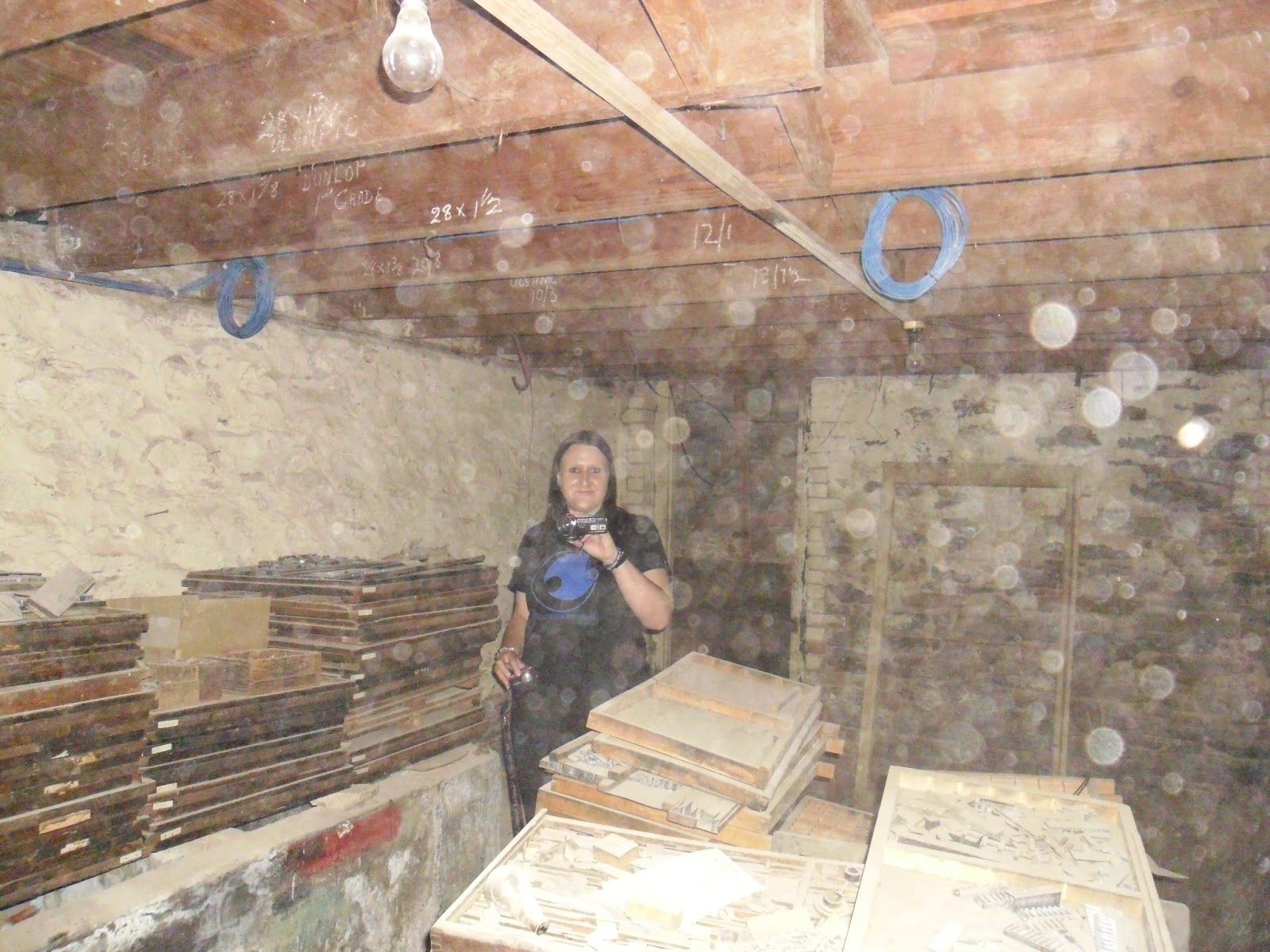
Karen and I were lucky enough to be invited by the newspaper's General Manager, Margaret, to investigate the Bunyip office and printing area. We had a tour of the location including the cellar, which still contained a lot of the old printing tools from the beginning of the 1900s. We also found another room adjacent to the basement that had long been sealed off, no doorways were visible into the room from the old hole in the wall through which we were looking, so we do not know exactly what the rooms use may have once been.

Karen in the Basement
The majority of the phenomena reported to us seemed to be taking place upstairs in the offices. We headed upstairs and started recorded a number of EVP's, with questions tailored to the research we had previously undertaken.
 We heard a couple of loud knocks during our EVP session, but they did not appear on the audio recordings, in their place, however, was low pitch sounds of a dog barking, which no-one in the room with us heard at the time.

The other allegedly active area was a downstairs office, where chairs had moved by their own volition and the sounds of someone sitting at a desk writing had been heard by numerous witnesses. This was intriguing, but on this occasion, we didn’t manage to capture anything on video or audio we would deem as paranormal in origin.

Perhaps the most intriguing alleged paranormal phenomena were the sounds of someone walking up and down the staircase in the centre of the building. Witnesses to this phenomena went to inspect who else was inside the building with them only to find the place securely locked down, and no one else inside!
  Through rigorous debunking, we ruled out the expansion and settling of the wood of the staircase and that of the building. We conducted a number of experiments to try and recreate the reported sounds, with no success. It would seem the person (or Ghost) that is responsible for the noise has some large heavy boots and really wants to be heard, but not seen!


© 2013 Allen Tiller