Tuesday, 25 April 2023

Cyril Peter Tiller (1916 – 1946)

Cyril Peter Tiller (1916 – 1946) 


 Cyril Peter Tiller (1916 – 1946) was born in Mallala, South Australia. His preference was to use his middle name when introducing himself. Peter was the sixth child and the youngest son of William (1877- 1951) and Sophia Tiller (nee Forby, 1880 – 1964).

 His brothers and sisters were: Ethel May Tiller (1903–1972), Hurtle George Tiller (1905–1975) Edward Mervyn Tiller (1907–1985), Gladys Catherine Tiller (1910–1993), Dora Rowett Tiller (1913 – 1986), and Thelma Irene Tiller (1918–2003).

  In the 1930s, Peter moved to Monash, in the South Australian Riverland where he worked as a nurseryman.[1]  Peter enrolled with the A.I.F. for World War Two at the age of 24 on 8 July 1840. He was working as a labourer in Mallala at the time.
  Peter was discharged from military service on 12 November 1945 at 29 years and 8 months. He served in the Middle East (10 July 1941 – 16 March 1942) and at New Guinea (19 October 1944 – 20 August 1945). Peter achieved the rank of Private in the AIF. His War Badge No: 50965. His Service No. SN SX8696.[2]

  After his return from World War Two, Peter moved to Queensland to work as a nurseryman at Deagon. He met Helen Joyce Kratzmann (1913 – 1978), who had separated from her husband, Colin Jamieson. Kratzmann intended to divorce her husband and marry Peter. Peter and Helen had a son together, Peter George Tiller.

  At 6:58pm on February 28, 1946, Peter was hit by a train at Deagon Train Station, Queensland. Francis Glenwright, a fifteen-year-old, witnessed the train bearing down on Peter, but failed to warn him, as he was terrified of trains. He admitted during an inquest in Peter’s death that he saw Peter walking across the pedestrian crossing but froze with fear when he realised what was about to happen.[3] Glenwright stated that a train was leaving Deagon Station for Brisbane, and another was entering Deagon station from Brisbane. He watched the man enter the pedestrian crossing not realising a second train was bearing down on him. Glenwright closed his eyes when the train was a foot away from hitting Peter. He admitted that he had been hit by a train as a 10-year-old, and despite riding trains, they terrified him.[4]
It was stated during the inquest that the crew of the train were unaware they had struck a person until they were advised later.[5]
 Peter's partner, Helen Kratzmann was interviewed. She stated that Peter seemed to be losing his hearing, and that may have contributed to his not seeing the second train. She stated that Peter had left home that evening to cross the line to the local general store to purchase some butter.
Police Constable R. A. McNaught, of the Sandgate police, had the final word, stating,

Tiller had been carried 142 feet. His death was accidental, and no negligence could be attached to any person. Tiller apparently was watching the train pulling out from Deagon and did not see the train coming from Brisbane. The inquest was closed.[6]

Peter suffered from severe head injuries and a mutilated foot after being hit by the train at Deagon Station on February 28.[7] Peter died at Brisbane Hospital on 2 March 1946.[8] Peter’s funeral details were listed in the Courier Mail newspaper as follows,

TILLER, Cyril P.— The Funeral of Cyril Peter Tiller (Interstate Gardens), Braun St., Deagon, will leave the Funeral Chapel, Wickham St., Valley, This (Monday) Afternoon, at 2 o'clock, for Lutwyche Cemetery.      K. M. SMITH. B2695.[9]


Cyril Peter Tiller is my great-uncle. I lived in Queensland in the early 2000s and visited his grave at Lutwyche Cemetery. Peter’s photo is also on display in the Mallala Museum.


Researched and written by Allen Tiller © 2023

[1] Cyril Peter Tiller, Australian Electoral Rolls, 1903-1980, (1939).

[2] ‘Cyril Peter Tiller.’, National Archives of Australia, (2023), https://recordsearch.naa.gov.au/SearchNRetrieve/Interface/ViewImage.aspx?B=6348467.

[3] 'Too Scared to Warn of Danger', Townsville Daily Bulletin, (10 April 1946), p. 1.

[4] 'Boy Too Scared', Cairns Post, (10 April 1946), p. 5.

[5] 'Too Scared to Give Warning', Morning Bulletin, (10 April 1946), p. 4.

[6] 'Scared-Stiff Boy Unable to Warn', The Telegraph, (9 April 1946), p. 3.

[7] 'Here It Is in Brief', The Courier-Mail, (1 March 1946), p. 3

[8] 'Advertising', The Telegraph, (12 April 1946), p. 8.

[9] 'Family Notices', The Courier-Mail, (4 March 1946), p. 8.

Saturday, 15 April 2023

Haunted Salisbury South Australia

 Haunted Salisbury South Australia


Haunted Salisbury: South Australia is the culmination of many years of research into the haunted history of Salisbury, South Australia by award winning paranormal historian, Allen Tiller. In this book, Allen Tiller investigates the origins of historic local hauntings and crimes, Salisbury’s founding, and the people who shaped the City of Salisbury, some of whom, are now alleged to haunt the places they lived and worked.
Allen Tiller is a university educated, award-winning paranormal historian from Gawler, South Australia. He was a member of the cast of television show Haunting: Australia, and the best-selling author of The Haunts of Adelaide: Revised Edition, and Haunted Adelaide, the first book in this series about hauntings, history and crimes in Australia.


Purchase your copy here: BUY NOW


Tuesday, 11 April 2023

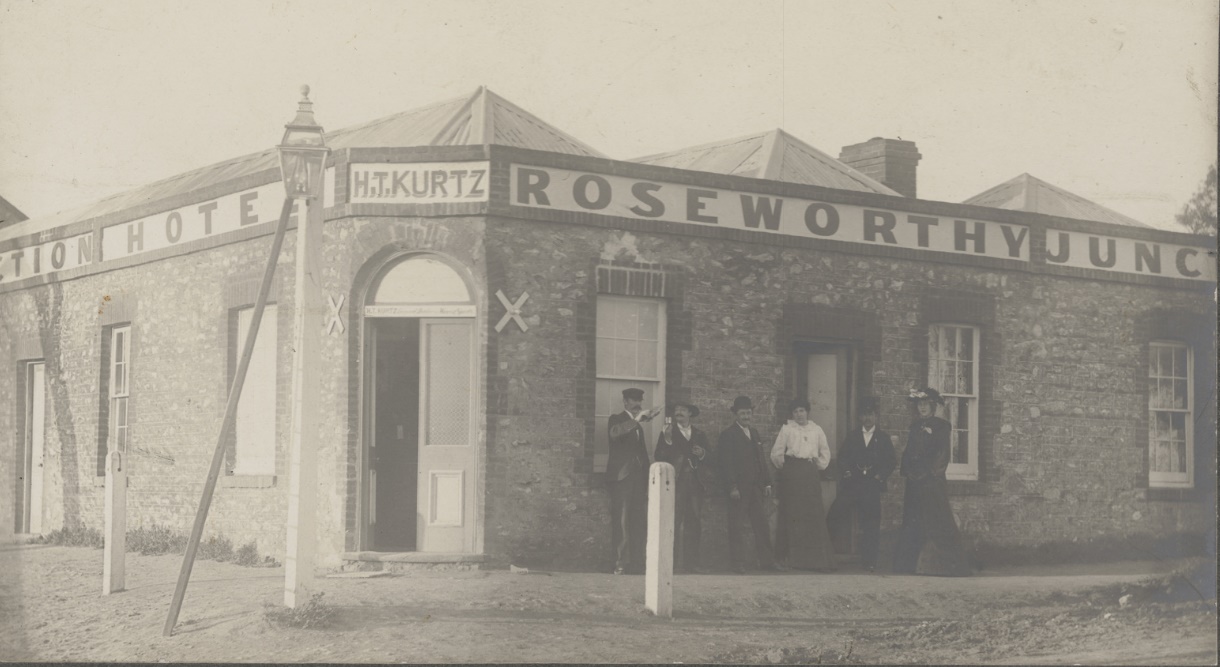
Lost Hotels: The Junction Hotel - Roseworthy.

Lost Hotels: The Junction Hotel - Roseworthy.


In 1867, plans were submitted to the Bench of Magistrates for licensing of a proposed hotel at Roseworthy. George Powning had his submission rejected as the board thought the dining room and bedrooms were too small for a hotel catering to the region at the time, especially one across from a train station.[1] Licensing for the hotel took almost a year to be approved. The first applications were presented in January 1867, but as the construction of the hotel needed to be completed the board did not think it appropriate to be open to service. It took a memorial signed by numerous people of the Roseworthy community to be presented to the licensing bench for approval to open be granted on 15 December 1868. The first publican was William Steed who ran the hotel from 1868 to 1902.[2]

As an interesting side note, the Bunyip newspaper printed in 1871 that the Roseworthy school was built through the efforts of Mr Steed, publican of the Junction Hotel, Roseworthy.[3]

H.T. Kurtz was the publican after Steed, having the hotel from 1903 to 1905. From 1906 to 1909, J. McFayden was the publican. E.A. Wickens was publican between 1910 and 1911, followed by Florence Jennings (1912), Chas. Nottle (1913) and then H.A. Payne 1914- 1916. Between 1917 and 1923 the publican was C. J. M. Lucas.[4]
 Mrs J Roberts was then publican between 1924 and 1926, followed by Mrs W. Roberts (1927) and William Roberts between 1928 and 1933. From 1936 until 1955, the publicans were Ethel Joyce and Colin Campbell Leitch. In December 1954 the Publican licensing board granted a transfer of the license to Colin Campbell Leitch from the Junction Hotel, Roseworthy to Leitch’s Hotel.[5]


The Junction Hotel license was transferred to Leitch’s Hotel, which was situated on Main North Road. The Hotel cost £20, 000 and was built at the junctions of roads that led to the Riverland, Gawler and Tanunda (pre-existing highways.) The hotel had 12 rooms with 6 bedrooms with ensuites and was designed by architects Walkley and Welbourn. It was built by the construction company J. Jenkins and Sons.[6]
The Hotel considered local farmers and the rising wine industry, with the News reporting that the hotel had a specialised round bar and a wine-tasting terrace. Steven Clark MP officially opened the new hotel on 18 March 1954.[7]

A Bunyip newspaper report stated that the ‘lounge accommodates 40 people and dining room 32…Outside the beer garden is set on a lawn, and the playground, with shell grit pit, includes a children’s slide and kanga-plane.”[8]


The former Junction Hotel was demolished in the 1960s.


Researched and written by Allen Tiller © 2023

Roseworthy Junction Hotel [B 45255], State Library of South Australia, (2023), https://collections.slsa.sa.gov.au/resource/B+45255


[1] 'BENCH OF MAGISTRATES.', South Australian Register, (24 September 1867), p. 3.

[2] J.L. Hoad, Hotels and Publicans in South Australia, (1986), p. 341.

[3] 'ROSEWORTHY SCHOOL DEMONSTRATION.', Bunyip, (2 December 1871), p. 3.

[4] J.L. Hoad, Hotels and Publicans in South Australia, (1986), p. 341.

[5] '2 hotels granted licences', News, (7 December 1954), p. 33.

[6] 'START ON HOTEL IN FORTNIGHT', News, (23 October 1953), p. 10.

[7] 'Bar outstanding', News, (15 December 1954), p. 37.

[8] 'NEW HOTEL HAS GALA OPENING.', Bunyip, (24 December 1954), p. 5.

Tuesday, 4 April 2023

Tracy Muzyk murder - update March 2023

 Tracy Muzyk murder - update March 2023


On a previous blog post – found here (http://hauntedadelaide.blogspot.com/2016/07/muzyk-murder.html), I detailed the gruesome murder of Tracy Muzyk. I have since spoken to family members and follow reports of those convicted closely.

 On 3 March 2023, ABC News reporter Candice Prosser published a report on one of the convicted murderers, Bruce McKenzie. McKenzie and four other people were convicted for the prolonged torture and murder of Muzyk in 1996. McKenzie was 18 years old when he was convicted. He was paroled in 2021 and placed in a pre-release centre, where he was caught in possession of contraband reported as “10 suboxone strips, a white parcel described by McKenzie as "smack", a packet of tobacco and a USB memory stick, hidden in his underpants.” [1]

McKenzie’s locker was also searched where nine mobile phones were found. He admitted to smoking cannabis “due to Covid isolation and harassment from other prisoners.”
In his defence, McKenzie stated that the contraband had been smuggled into the prison due to him being threatened by a group of men who ‘stood over’ him.


McKenzie was raised in Victoria, where his family still reside. His lawyer argued that it would be beneficial to McKenzie to be paroled to Victoria where he would receive support from his family. The South Australian Parole Board had no objection to McKenzie being paroled to Victoria, however, in doing so, the Victorian Parole Authority would assume supervision obligations for the rest of McKenzie’s life.

On 3 March 2023, The Supreme Court re-sentenced the 44-year-old McKenzie. Justice Kevin Nicholson, stated of Muzyk murder, "The many acts of torture were barbaric and inhuman. [McKenzie] was also only 18 years old. He had grown up within a dysfunctional family,"

"You told [a social worker] that you were involved in the assault on [Tracy] at the house and that you continued on out into the paddock, at the paddock, you tried to stab [Tracy] with a star dropper. You also picked up a rock which took two people to hold and dropped it on [Tracy's] head. You then stabbed her to try and kill her.
You told the social worker that the reason for your involvement was peer pressure because the others were egging you on. After leaving school, you moved from one youth refuge to another. You involved yourself with illegal drugs. On the day of the murder, you had taken heroin, and you described yourself as being 'off my face'."

After his concluding remarks, Justice Nicholson sentenced McKenzie to five months imprisonment, and another eight months non-parole period for the murder of Muzyk, which was backdated to August last year.[2]

McKenzie is due for release in May 2023.


[1] Candice Prosser, ‘Murderer who tortured Adelaide woman Tracy Muzyk to be released from prison within months.’, ABC News, (2023), https://www.abc.net.au/news/2023-03-03/tracy-muzyk-killer-ian-bruce-mckenzie-to-be-released-again/102049450.

[2] Sean Fewster, ‘Torturer, murderer back behind bars months after parole.’, The Advertiser, (2023), www.adelaidenow.com.au%2Ftruecrimeaustralia%2Fpolice-courts-sa%2Ftracy-muzyk-murderer-ian-bruce-mckenzie-back-behind-bars-for-trying-to-bring-drugs-into-prerelease-centre%2Fnews-story%2F53d19fc3254381e89106aeb573ae45e2&memtype=anonymous&mode=premium&v21=dynamic-high-control-score&V21spcbehaviour=append.

Tuesday, 28 March 2023

A Haunting at Waterhouse Chambers

 A Haunting at Waterhouse Chambers


Waterhouse Chambers was built by successful grocer Thomas Greaves Waterhouse, who had invested heavily in the Burra Mines and made a small fortune in return.

 Waterhouse used his earnings to construct the impressive building, which was so iconic at the end of Rundle Street, that the corner became known locally as “Waterhouse Corner”, before being usurped as “Beehive Corner”, when the even more impressive “Beehive” building opened across the road.
 The building has seen many uses, including, at one time, being used as the head office of the South Australian Mining Company.

The building left the ownership of the Waterhouse family in 1919 after A. Waterhouse sold it to F.N.  Simpson of Gawler Place through realtor J.S. Kithor. In 1921 Kithor would on-sell the building to tobacco merchants “Lawrence and Levy” who remodelled the ground floor shop front.

After ninety years of occupying a section of the building, Shuttleworth and Letchford moved their offices to the YWCA building on Hutt Street.

 The building has seen many tenants over the years but perhaps one of the best-loved was the 44-year occupation by the iconic confectioner, Darrell Lea before the current Tennant, Charlesworth Nuts took over in 2013.

Ghost Stories:

Long rumoured to be haunted amongst the local paranormal community, ghost stories for this particular building are very hard to come by, but it would seem, that the majority of stories that have surfaced involve the upstairs section of the building.
 It has been reported that staff do not like the feeling of the upstairs room, reports of paranoia, smelling phantom pipe tobacco smoke when clearly no one is smoking, and hearing loud footsteps in rooms have surfaced.
 At one point this led staff from a downstairs shop, which used the upstairs as storage, to abandon the upstairs section as no one wanted to enter the rooms for fear of the unknown. If it is haunted, it has yet to be investigated by a professional paranormal investigation team or group of sceptics to find the cause of fear and paranoia! 


Trivia: Before the imposing Beehive building was built the corner of King William Street and Rundle Street was known locally as “Waterhouse Corner”.


This story was originally written for the Adelaide City Library project "Haunted Buildings in Adelaide." For a more complete history of the building and eyewitness accounts of ghost stories at this building please refer to my book "Haunted Adelaide" available via Amazon here: Haunted Adelaide

© 2016 Allen Tiller

Tuesday, 21 March 2023

A Haunting at the Mount Remarkable Hotel - Part VII - Conclusion + Ghost Stories.

A Haunting at the Mount Remarkable Hotel
- Part VII -
Conclusion + Ghost Stories.


At the end of my first post in A Haunting at the Mount Remarkable Hotel, I mentioned that there were several recorded deaths at the hotel. Each week I have supplied research on those deaths. Starting with watchmaker Dugald Wilson who fell into the basement, dying in the hotel that evening. Then Margaret ‘Maggie’ Salmon who suicided by poison in 1866. The next death was another suicide, that of August Fix who shot himself in an outlying building in 1908. In 1915 George Moran, son of the original owner, Thomas Moran died suddenly from a cerebral haemorrhage, and in 1931, the death of Irene Wight, followed by her husband Harry Castle Wight in 1932, who died ‘suddenly’.

So how do these deaths fit in with the local ghost stories?

The Mount Remarkable Hotel is alleged to be haunted by three (or more) ghosts. The first is a young woman who it believed may have drowned in the cellar. The second is thought to be the spirit woman and the third is a male who presents himself as a shadow person.
Owners have reported hearing people running through the unused upstairs section of the hotel. Poltergeist-like activity is also reported, with witnesses claiming to watch a bar stool topple over of its own volition, and cups from the pokies room being found on the floor in the morning during the opening of the room, which wasn’t there the night before.

I can find no corroborative evidence for death by drowning in the cellar. One would expect that such an event would require an inquest and that the inquest would be published in a newspaper. The second alleged spirit, without a description of what she looks like, could literally be anyone, but one could assume that the female spirit may be Maggie Salmon or Irene Wight.
The third alleged spirit that appears as a shadow person could literally be anyone, but again, one can make an assumption that the spirit may be Dugald Wilson, George Moran or Harry Wight. Without a proper description and a proper paranormal investigation done by professionals, it is hard to identify or conclude who any spirit is in any location.

Other alleged ghostly activity at the Mount Remarkable Hotel is poltergeist activity. With claims that cups appear in places they shouldn't be on opening the hotel. Often, things like cups left in a room are related to memory or misinterpretation. A person closing a hotel may think everything is away, having a brief look before locking up, then return the next day and be surprised when something is where it should not be, having missed it the night prior. However, there is always the possibility of a spirit moving things – there has been prior evidence of this in South Australia at the North Kapunda Hotel, The Port Admiral Hotel (Port Adelaide), and The British Hotel (North Adelaide).

Although I have linked ghosts to known deaths and made assumptions, this is unreliable and should not be regarded as evidence of the named people being ghosts in this location. If there are spirits haunting this hotel, they remain unidentified, and could literally be anyone who has passed through the building, or simply urban legends...


Researched and written by Allen Tiller © 2023


Tuesday, 14 March 2023

A Haunting at the Mount Remarkable Hotel – Part VI – Sudden Death.

 A Haunting at the Mount Remarkable Hotel 

– Part VI – 

Sudden Death.


Harold Wight served during World War One in Egypt, where he contracted Malaria. At the time of his embankment, he and Irene were living at 162 Jetty Road, Glenelg.[1]Harold Castle Wight and Irene Pearson Wight (nee Taylor) had one child Nina Marie Castle Wight.

Prior to owning the Mount Remarkable Hotel, Harry and Irene owned the Aurora Hotel at Hindmarsh Square, Adelaide. Harry was prosecuted in court for illegally supplying liquor on Christmas day and fined 10 pounds and 1-pound costs.[2]
 

Only a few years later the Wights were in trouble again for the illegal supply of liquor, however, this time they were found innocent.

Harry Castle Wight (48), on complaint, charged with a breach of the Licensing Acts, 1917 to 1927, section 183, at Mount Remarkable Hotel, Melrose; complaint dismissed. Tried at Melrose on 22/1/29. Evidence obtained by M.C. Jones.[3]

Wight bought the Mount Remarkable Hotel from Clarence Fuller in 1928. In 1929, Wight tried to sell the Mount Remarkable Hotel and its furniture and fittings.[4]


Irene died at the Mount Remarkable hotel on 25 august 1932, aged 43 years. Harry died on 29 March 1932 at the Mount Remarkable Hotel, aged 46 years.[5]They were both buried at Saint Jude’s Cemetery in Brighton, South Australia.[6]

After the deaths of the Wights, the hotel was sold to Herbert Ey.[7]


Next Week: A Haunting at the Mount Remarkable Hotel - Part VII - Conclusion + Ghost Stories.

Researched and written by Allen Tiller © 2023.

[1] ‘WIGHT Harry Castle: Service Number - 15400: Place of Birth - Adelaide SA: Place of Enlistment - Adelaide SA: Next of Kin - (Wife) WIGHT Irene,’ National Archives of Australia, https://discoveringanzacs.naa.gov.au/browse/records/418631.
[2] 'ILLEGAL SUPPLY OF LIQUOR.', The Advertiser, (26 January 1926), p. 7.
[3] ‘Harry Castle Wight’, South Australia, Australia, Police Gazettes, 1862-1947, AU5103-1929 SA Police Gazette, (1929).
[4] 'Advertising', The Advertiser, (18 December 1929), p. 9.
[5] 'Advertising', The Advertiser, (30 March 1932), p. 4.
[6] 'Family Notices', News, (26 August 1931), p. 12.
[7] J.L. (Bob) Hoad, Hotels and Publicans in South Australia, (1986), p. 390.