Today we trace the origins of the land and building that is known today as “Carclew House” a Gothic-styled mansion that sits adorning Montefiore Hill in North Adelaide.
"Sinister By Design Part 2"
Last week we were introduced to Carclew's designer, Mr John Quinton Bruce, this week we delve into the house's history and a little of the history of the family that resided in its walls and named this South Australian icon “Carclew House”.
Long before the iconic house was built, a much smaller residence sat upon the hill, that of James Chambers and Family.
Mr Chambers was a very successful businessman in Adelaide in the late 1800s. Much of his families success came from buying a town acre in the first Adelaide land sale and importing horses from Van Diemen's Land in conjunction with his brother John.
The two men secured themselves a small fortune through their business dealings, and become philanthropists in the small Adelaide community.
James opened a livery stable in Adelaide, purchasing coaches from Cape Town and England, soon he gained the mail contract to Burra (around 1845) and built a large business carting people and mail to the mining communities in Kapunda and Burra and Mid North.
 |
| Hugh R Dixson |
The house on Montefiore Hill was eventually sold to Mr Hugh R. Dixson, a tobacco manufacturer and merchant, who knocked it down and commissioned local architect, John Quinton Bruce to build an imposing mansion, which he named “Stalheim” in 1897.
Mr Dixson worked for his father from 1885 and in 1889 went to Perth, Western Australia, where he married. On the death of his father in 1891 he bought the S.A. and W.A. businesses from his father's estate and returned to Adelaide to live.
In 1903 the Dixson company merged with another company and become known as “The British Australian Tobacco Company", of which Dixson was elected the director. He moved his family to Sydney to live in 1905.
In 1908, Stalheim was sold to Sir Langdon Bonython, who renamed the building “Carclew”.
 |
| State Library of South Australia photo by Ernest Gall 1867 |
Bonython was 16 years old when he took a job at “The Advertiser”, one of Adelaide's daily newspapers. In 1879, he entered the business as part proprietor and by 1894 owned the newspaper business outright. He went on to own the newspaper for another 35 years, establishing a number of other media ventures in that time as well.
It was reported in another Adelaide paper, “The Mail” in 1929, that Bonython sold his stake in the Advertiser for £1,250,000 to a Melbourne consortium. At the time, this deal made him the wealthiest man in Australia.
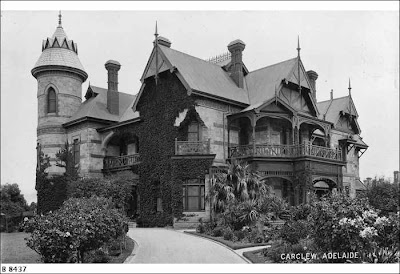 |
| The southeastern facade of the Carclew House 1910 |
Bonython entered politics in 1901, and in 1903 was elected unopposed in the division of Barker. He retired from politics in 1906
n 1908 he was appointed a Companion of the Order of St Michael and St George(CMG) "In recognition of service to the Commonwealth of Australia".
Sir Bonython was well known for his good deeds and philanthropy, in 1916 he donated £50,000 for the construction of a hall at the University of Adelaide.
He also donated £100,000 towards the construction of Parliament House in Adelaide.
In 1919 he was appointed Knight Commander of the Order of St Michael and St George (KCMG) "In recognition of service to the Commonwealth".
The Bonython family lived happily in the newly named Carclew House from 1908 until its sale to the State government in 1965.
 |
| 1930 |
Sir Bonython was a distinguished-looking gentleman, short of stature but well-groomed, he was said to a very stern and strict man with his children, possibly even a little harsh for the time he lived in, but he expected much from his offspring, and drove them to strive for greatness themselves.
Sir Bonython was said to be a man of extreme cleanliness and had a distaste of anything that may harbour germs. He lives a long life, dying at the age of 91 on October 22nd 1939.
He was honoured with a State Funeral, with a service at St Peters Anglican Church, and was interred in West Terrace Cemetery.
His estate was vast upon his death, with a net worth estimated at around £4,000,000. He included as beneficiaries in his will, The Pirie Street Methodist Church and St Peters Cathedral, to which he had donated the cost of the canons and choir stalls in 1925 in memory of his wife who had died in 1924.
 |
| State Funeral of Sir Bonython |
Of the stories of ghosts and haunting associated with Carclew House, one tale is of Sir Bonython killing his wife. The story goes that Mrs Bonython found out Mr Bonython had a mistress and grew incredibly angry, a fight ensued. It is alleged that he incapacitated Mrs Bonython, carried her to the spire tower and threw her out the window in a fit of rage.
When he got down to the grounds below to his wife, he found her still alive, so he carried her back up the spire and threw her down again!
Whether or not the story is true has not seemed to matter in the annals of South Australian history, people never let the truth get in the way of a good story, and this is a story that has it all.
That said, what did happen to Lady Bonython?
Lady Marie Louise Fredericka Bonython died on the 9th of February 1924. It is reported in “The Register” obituaries that Lady Bonython had been an invalid for many years before her death.
 |
| Obituary of Lady Bonython in 1924 |
She was a jovial woman, always in high spirits who showed a great deal of compassion and consideration for other, this earned her much respect.
She had spent 20 years serving on the board of the States Children Council and was a founding member of the District Trained Nurses Society.
Up until her death, she worked tirelessly as the Vice-President of the Kindergarten Union.
In 1920, She celebrated her Golden wedding anniversary with her husband having married him on December 24th 1870
She was survived by her husband, her son, Mr Lavington Bonython, Lord Mayor Of Adelaide, and three daughters.
So was Mrs Bonython murdered, thrown from the tower by her husband?
It would appear not, as one would expect police and coroner reports, as well as media scrutiny with a family so much in the public eye.
From a conspirators point of view though, such a tragic murder could easily have been covered up, with Media control of local newspaper source, a Son in the Mayor's office, an abundance of money and power, Sir Bonython could have easily covered up such an event, but as we all know, the truth has a way of exposing itself, and if such an event did occur, it will find its way into the public forum eventually, but for now all we have is speculation as to whether or not such an abominable event occurred in the grand old House named “Carclew”
Other persistent rumours include stories of a man being buried inside the walls of one of the rooms and of a man being buried in a wall near the front door, there is no evidence at the moment that confirms of either of these events ever taking place.
 |
| Carclew house 2010 |
So what of the Carclew house today?
In 1965 the house was bought by the Adelaide City Council.
In 1971, then premier, Sir Donald Dunstan announced Carclew would become a performing arts centre for youths.
In 1976 the program was expanded, and Carclew became a place of multi-arts activities for youth.
In October 2006 Swanbury Penglase Architects prepared an extensive report on the condition of Carclew House – making a series of recommendations to ensure the long-term structural viability of the building. These works were undertaken by the Government of South Australia and completed in October 2009.
© 2012
The Haunts of Adelaide
All photos retain the rights of their various copyright holders and only shown here for the purpose of education,
All reference materials available upon written request.


 There are stories of
shadow people, stone-throwing ghosts, and some local legends of satanic rituals
happening in the 1970s – this all adds to the myths and legends of the location - which is still a popular place in South Australia to ghost hunt or
scare people.
There are stories of
shadow people, stone-throwing ghosts, and some local legends of satanic rituals
happening in the 1970s – this all adds to the myths and legends of the location - which is still a popular place in South Australia to ghost hunt or
scare people.


