Showing posts with label paranormal investigation. Show all posts

Tuesday, 18 July 2017

Into The Unknown


Into The Unknown

First published in Heart-Soul & Spirit Magazine, Issue 2 July/August 2014, pgs 37,38
 

 As a paranormal investigator, it is your job to walk into the realms of the unknown at every investigation, sometimes walking into places where Angels themselves would fear to tread. You never know what is behind that next door, what is lurking in the shadows around every corner, or what may decide to follow you back to the safety of your very own home.
 Some may scoff at such a thought, “why would a spirit wish to follow me home”?
Good or bad, have you not just asked the very spirit to communicate with you?
 Would a spirit not be just as inquisitive about you as you, are it?
 Also, you've entered its territory to communicate, why can the spirit not enter your home to do the very same?

 There is also the negative connotation to such a thing, a negative entity that wishes to cause you distress and harm, and “feed” on that negativity for its owns reasons.
 I can tell you from experience in this field, that this is not a laughing matter. That spirits and other entities can, and will follow you home, at their will, and leave at their pleasure.

   Not too many years ago I had visited a known haunted location in the town of Gawler, South Australia. I finished my investigation, headed home, and went to bed about 3am. Within an hour of falling asleep I was awoken abruptly by the foot of my bed lifting off the ground and slamming into the cement floor hard enough to take a large chip out the concrete. I of course, waking up so abruptly, was in a state of panic not knowing what was happening. I switched on a light and the heavy atmosphere and lingering feeling of danger vanished in an instant.
I eventually laid back down and fell asleep.

 The next night, I was in bed before midnight, and again, within an hour the bed was shaking abruptly. Being a little bit cluey to these type of communications, I had prepared a torch under my pillow. I swung the bright torch light up to see the shadow of a woman disappear in a flash.  No-one else was in the room, No-one else in the house.
Just me.
Alone.
Left to ponder two nights of goings on.


 After work the next day, and a long time to think upon the nightly goings on, I came to the conclusion that this spirit may want to communicate only, and may not be harmful, despite my feelings on the first night.

 The spirits actions on night three changed that opinion very quickly.

 On the third night of the bed shaking, the slamming of the bed was much more abrupt, the atmosphere was much more sinister, and when something unseen, cold and harsh grabbed at my leg, that was enough for me to decide to try and move this spirit on.

 At the time, I wasn't a religious person, and my objective was to only document spirits. As I am not a psychic, I did not believe I hold the power to move a spirit on to wherever it is spirits move on too.
 Instead, I sought out different techniques to solve my problems, and went as far back as I could researching into medieval practices. It seems in more “superstitious” times that there was a remedy for everything, but particularly for spirits and other entities.

I read about Vampires being distracted with piles of sand or rice.
That the Vampire is compelled to count, and therefore too distracted to feed upon its victim, funnily enough, this was also an attribute to stop ghostly activity.
 I read about doors painted red, mirrors placed on the back of entry doors with the reflective side pointing out (theory being the ghost would see its own reflection and scare itself). Another interesting remedy was a shiny metal bowl with water inside placed in the room within which the spirit resides, the spirit looks into the reflective water, and is trapped within it. The water, in the morning, can be poured over a tree grounding the spirit. There was one other technique, that I thought would be the simplest for me to try, as all it required was a pair of shoes.

 At the end of any bed that is being moved by a spirit, place a pair of shoes at the foot of the bed before going to sleep for the night. Place one shoe pointing toe first to the bed, and the other heel end to the bed, next to each other on the floor.
Apparently, spirits will become so confused by this, that eventually, after a few nights they will leave out of frustration.
I tried this for myself, and it seemed to work for me. Skeptics will say it is the power belief, and perhaps they are right, but whatever the reason, the bed never shook that hard again for the rest of the time I lived in that particular house.

 Now days, I am much more informed and experienced in the way I approach the spirit realm. I show them the utmost respect and courtesy, and expect the same to be shown to me in return. I often say a couple of prayers before and after an investigation, including St Michael's Prayer for protection, and within those prayers I ask for any spirit to un-attach from me and to not follow me home.

 My wife Karen also has a ritual she has developed for our team, that involves cleansing ourselves with holy water, blessed objects and crystals.
 I have heard many people laugh at such notions, and some say they would prefer the “whole” experience and have no protection at all, but as I always say;“It is always better to be safe than to be sorry”, and that stands true when working with any aspect of the paranormal or spiritual realms.

 Be respectful.
 Be prepared.
 Be protected.
 Be safe.

Wednesday, 22 February 2017

Perception & the Paranormal: Top Down Processing


Perception: Top Down Processing


At any given time whilst investigating the paranormal our senses are exposed to a limitless amount of sensations. Sounds, smells, sights, textures, light and darkness, touch, all flooding your central nervous system and brain which then must process all these events at once, to give you what you perceive as reality.
 We can break these systems down to two essential processes;


 Sensation; what we are feeling through our senses.


Perception; how our brain deals with the sensory input and then make sense of the input information.

In general, these two terms, when put together, are referred to as Processing.


In psychology, there are generally two types of processing, Schema-Driven (Top Down Processing) and Data-Driven (Bottom Up Processing). In this article, we are looking only at Top-Down Processing as a perception that may lead a paranormal investigator to perceive an anomalous event as “paranormal” when it is a natural event misinterpreted by pre-conceived notions or biases.
 Many paranormal events can be explained by various cognitive mechanisms such as fantasy. The way we analyse statistical probabilities and anecdotal evidence can also lead us to draw faulty conclusions when it comes to anomalous events.


An example of this is demonstrated live by Professor Chris French of the Anomalistic Psychological Research Unit at Goldsmiths College, University of London. In his demonstration, Professor French plays a recording of Led Zeppelin’s “Stairway to Heaven”” in reverse.
 The recording makes no sense in reverse and sounds like garbled words. It is not until Prof. French puts forward what other people think is being said within the reverse recording, that listeners begin to hear the same phrases that he has suggested.
 This is common in the paranormal community with EVP recordings – without the text suggesting the words in an EVP video, people will hear all kinds of different words or sounds, but once it has the context of words added, people will almost always hear the words suggested.
 

We often experienced a variation of on ghost tours we hosted. People would come to the tour hyped up (we referred to it as “hypersensitive”) expecting to see, feel, hear or be touched by a “ghost”. The slightest change in temperature, a creek of a floorboard or something that is easily explainable, these people, through no fault of their own, other than the hype (and “legend Tripping”) would believe the interaction was paranormal in nature – when, clearly, to myself and my wife, it was not.
 This is an excellent example of a schema-driven process, the experiencer is processing information based on prior knowledge and influence, and making a fantasy inspired conclusion on a misperception.


Top-Down Processing: The brain is at the top of the cognitive processes, therefore thought comes before perceptions, such as the senses like touch, sight etc. using contextual information in pattern recognition.
 An example of this is understanding difficult to read handwriting. It is easier to understand a complete sentence due to the context of the words around it, rather than the individual words with no context.

Bottom-Up Processing: Simply put, this is the processing of information in the reverse of Top Down Processing.  The body reacts first, causing emotion, which triggers the brains cognitive process, engaging thought, then action. You may be a Bottom-up processor if your understanding of concepts begins with the ideas behind a concept, then working your way up to the main idea of a concept.


The Necker Cube:


The ambiguity of perception is best explained with the example of The Necker Cube. When you stare at the crosses on the cube the orientation can suddenly change, or 'flip'.

It is argued that the object appears to ‘flip’ because the brain creates two plausible propositions for the orientation of the object and it, therefore, cannot decide between the two options.

There is no change in sensory input, therefore the perception of distance must be set downward by prevailing perceptual hypothesis of what is near and what is far – top down processing.  


The Stroop Effect, named after its discoverer, J. Ridley Stroop who discovered the phenomenon in the 1930s, is a classic example of Top-Down Processing.

The Stroop Effect contains several colours written as words, but printed in a different colour than the word read. So, for instance, the word “blue” might be written in green text, the word “Pink” might be written in the colour yellow.

The idea here is to say the colour of the word, but not say the word itself – so for our previous examples, the correct answers would be “green” and “yellow”. When reaction times are calculated, people are much slower at saying the correct colour when the colour and word are different.


Want to test your skills with the Stroop Effect – go here: https://faculty.washington.edu/chudler/java/timesc.html


Written and researched by Allen Tiller © 2017

Bibliography

2017. Top-Down Processing: Examples & Definition - Video & Lesson Transcript | Study.com. [ONLINE] Available at: http://study.com/academy/lesson/top-down-processing-examples-definition-quiz.html. [Accessed 22 February 2017].

Bottom-Up Processing definition | Psychology Glossary | alleydog.com. 2017. Bottom-Up Processing definition | Psychology Glossary | alleydog.com. [ONLINE] Available at: http://www.alleydog.com/glossary/definition.php?term=Bottom-Up%20Processing. [Accessed 22 February 2017].

Classics in the History of Psychology -- Stroop (1935). 2017. Classics in the History of Psychology -- Stroop (1935). [ONLINE] Available at: http://psychclassics.yorku.ca/Stroop/. [Accessed 22 February 2017].

Cognitive Mechanisms. 2017. Cognitive Mechanisms. [ONLINE] Available at: http://changingminds.org/explanations/behaviors/coping/cognitive_mechanisms.htm. [Accessed 22 February 2017].

Neuroscience For Kids - stroop effect . 2017. Neuroscience For Kids - stroop effect . [ONLINE] Available at: https://faculty.washington.edu/chudler/words.html. [Accessed 22 February 2017].


Sincero, SM, 2013. Top-Down VS Bottom-Up Processing. [ONLINE] Available at: https://explorable.com/top-down-vs-bottom-up-processing. [Accessed 22 February 2017].

Watt, Caroline; Wiseman, Richard. The Journal of Parapsychology; Durham66.4 (Dec 2002): 371-385.

Tuesday, 12 February 2013

The Bunyip: The Ghosts of Gawler Part Four


The Bunyip

The Ghosts of Gawler Part Four


  The Bunyip Newspaper began its existence in 1863 as a monthly pamphlet published in collaboration with  "The Humbug Society". Editor Dr George Nott and printer, William Barnet teamed together to create what was to become South Australia's longest-running family-owned newspaper.

When the paper began, it was a satirical look at life around Gawler. Later, it was to become a weekly "orthodox" newspaper, still with a strong community focus, but expanding into further suburbs and country areas surrounding Gawler.

 The Bunyip Newspaper, in its early life, was situated in a shop near the Baptist Church in Murray Street, Gawler. Later its offices were moved further along Murray Street to be situated near the Prince Albert Hotel. Those premises were destroyed by a fire and 'The Bunyip' relocated to its present location, of which it has remained in since 1885.

The Bunyip Newspaper was sold to the "Taylor Group" of newspapers in 2003 by the Barnet family, ending the families long ownership of this local icon (September 1863 until April 2003).

The haunted staircase
Since the sale, The Bunyip has seen many changes in formatting, design and presentation, including the adding of colour to its format. The Bunyip continues to be one of Gawler's most respected icons and sources of news and entertainment, The Bunyip contributes to a great many of the events of the town, with sponsorship and support and continues to be the best resource for local news and events.

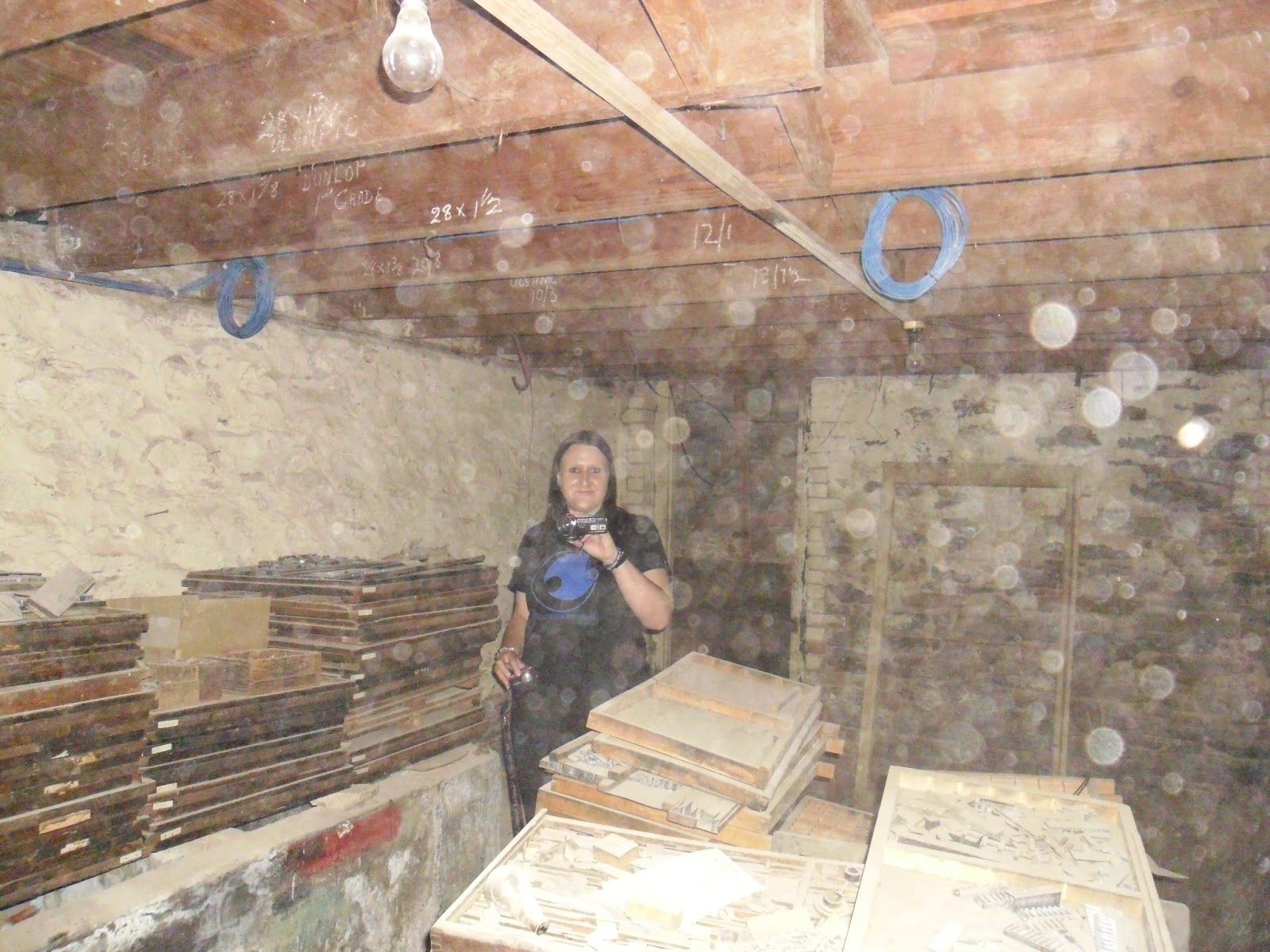
Karen and I were lucky enough to be invited by the newspaper's General Manager, Margaret, to investigate the Bunyip office and printing area. We had a tour of the location including the cellar, which still contained a lot of the old printing tools from the beginning of the 1900s. We also found another room adjacent to the basement that had long been sealed off, no doorways were visible into the room from the old hole in the wall through which we were looking, so we do not know exactly what the rooms use may have once been.

Karen in the Basement
The majority of the phenomena reported to us seemed to be taking place upstairs in the offices. We headed upstairs and started recorded a number of EVP's, with questions tailored to the research we had previously undertaken.
 We heard a couple of loud knocks during our EVP session, but they did not appear on the audio recordings, in their place, however, was low pitch sounds of a dog barking, which no-one in the room with us heard at the time.

The other allegedly active area was a downstairs office, where chairs had moved by their own volition and the sounds of someone sitting at a desk writing had been heard by numerous witnesses. This was intriguing, but on this occasion, we didn’t manage to capture anything on video or audio we would deem as paranormal in origin.

Perhaps the most intriguing alleged paranormal phenomena were the sounds of someone walking up and down the staircase in the centre of the building. Witnesses to this phenomena went to inspect who else was inside the building with them only to find the place securely locked down, and no one else inside!
  Through rigorous debunking, we ruled out the expansion and settling of the wood of the staircase and that of the building. We conducted a number of experiments to try and recreate the reported sounds, with no success. It would seem the person (or Ghost) that is responsible for the noise has some large heavy boots and really wants to be heard, but not seen!


© 2013 Allen Tiller