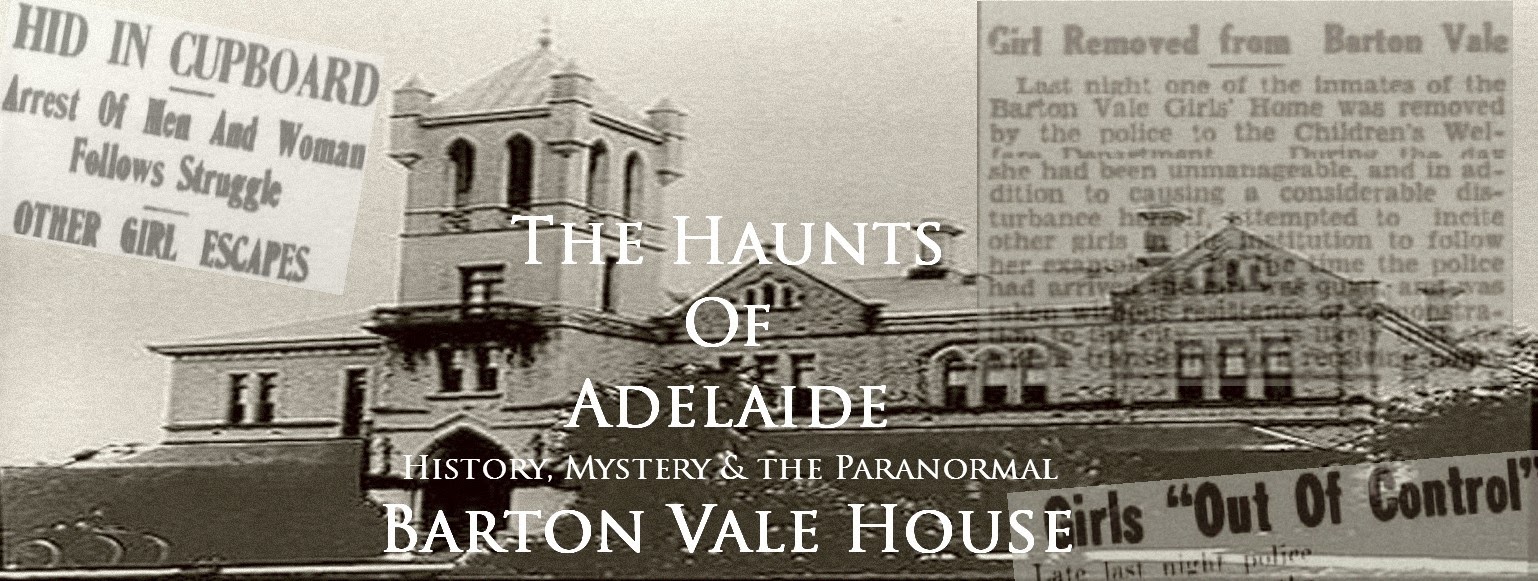
Barton Vale House
Barton Vale: From Colonial Mansion to Urban Legend
Built between 1850 and 1852 by pastoralist Edmund Bowman,
Barton Vale is one of Adelaide’s earliest and most striking Victorian Gothic
mansions. Bowman sought to construct the house as economically as possible
while still achieving excellence in craftsmanship and style. Using local
materials and tradesmen, he created a residence that quickly became one of the
most impressive homes in the colony.
Sadly, Bowman did not enjoy Barton Vale for long. He died in
1866, and his widow later remarried. With her new husband, she undertook a
significant refurbishment of the house in 1880.
On Tuesday, 23 August 1881, The South Australian
Advertiser published a detailed architectural description of Barton Vale,
having been granted access for inspection by local builders and architects. The
article outlined room sizes, décor, and interior features — a treasure for
history enthusiasts today.
In 1922, following the death of Hubert Bowman, the estate was sold by order of the Supreme Court. The auction lasted several days due to the sheer volume of goods within the home. Barton Vale itself was purchased by the Salvation Army, which converted it into a “home for wayward girls.” During this period, the mansion was known as Barton Vale Home, and many young women passed through its doors for various misdemeanours.
The home frequently appeared in newspapers. One notable
incident, reported on 17 July 1930 in the Register News, involved a
violent disturbance and an attempted mass escape that required police
intervention.
In 1947, Barton Vale was sold again — this time to the State
Remand System. Renamed Vaughan House, the change caused controversy,
with the Enfield Council objecting to the new name.
The building’s troubled reputation continued. Breakouts were
common, including one case where two girls absconded for five days disguised as
boys. On 15 December 1953, police were called after residents became unruly.
Before officers arrived, several girls climbed onto the roof, shouting abuse at
police and curious locals who gathered outside. They remained on the rooftop
until nearly sunrise.
By the 1980s, Barton Vale stood abandoned. Windows were
smashed, vines overtook the façade, graffiti covered the interior, and the once‑grand
mansion was in a severe state of decay. The State Government considered
demolishing it, but the Enfield Historical Society successfully campaigned for
a National Trust listing and restoration.
Government funding was allocated in 1991 to restore the
building for use as offices. During restoration, the tower — removed in 1944
due to structural strain — was replaced with a lightweight fibreglass and steel
replica, restoring Barton Vale’s original silhouette.
Midway through the restoration, the Government decided it no
longer required the building and placed it on the market. Collaroy Developments
purchased the property, subdividing the five‑acre estate into a housing
development and leaving Barton Vale on a single acre.
In 1995, Peter and Marilyn Smith purchased the mansion and
began a painstaking restoration of the interior, returning the home to its
former grandeur. Today, Barton Vale serves partly as the Smith family’s private
residence and partly as headquarters for their business ventures. It is
beautifully maintained and in caring hands.
Ghost Stories and Local Lore
The ghost stories surrounding Barton Vale largely stem from
the period when the mansion stood empty and derelict. As with many abandoned
grand homes, local youth spun tales of ghostly girls on the staircase and a
stern matron chasing trespassers away. These stories grew into urban legends
passed down through generations.
From the beginning of restoration in 1991 to the present
day, no builders, owners, or workers have reported paranormal activity. It
appears the hauntings of Barton Vale are simply folklore — stories meant to
keep adventurous children from entering the old, crumbling mansion.
© 2014 Allen Tiller
www.allentiller.com.au