Tuesday, 26 February 2013

Para-Para: Ghosts of Gawler: Part 6


The Ghosts of Gawler Part 6

Para-Para


Para-Para Mansion, an icon of Gawler, situated in what is now Gawler West. 
Having grown up very nearby, it wasn't unusual for myself and my friends to wander onto the Para-Para estate as boys, walking along the river, we would find ourselves in the backyard of the mansion's property on occasion and marvel at all the farm equipment strewn about the place.
Of course, having grown up in Gawler, and going to school nearby, I inevitably heard the rumours of the Mansion being haunted. 
There were a great many stories to tell, most coming from when the building was unoccupied for many, many years, my favourite one isn't so much a ghost story but a practical joke of sorts, that could well have been an urban legend, it went something like this.

A group of older school boys led some younger schoolboys to the mansion to tell them some ghost stories, and generally spook the younger lads. They peeked through windows at the somewhat derelict insides, room by room, telling the boys stories of murders and suicides, when they got to the last room, the younger boys would freak out and run away...of course the older boys would fall on the ground in hysterics, because much earlier they had broken in and nailed all the furniture to the roof, making it seem, in the gloom of the evening, as though the furniture was floating up there!

Two other ghost stories I can remember, one involves a young lady committing suicide. She had fallen for a young man but had found him sleeping with the Mansions maid, she flung herself down the staircase and broke her neck. It was always rumoured that if you peeked through the glass of the door you would see her white face peek back.

The other notable story from my childhood involved a man of the house, who was someone of importance, being found by his wife having sex with the housekeeper in front of an open fireplace on the bottom floor.
 In her shock she grabbed a fire poker and stabbed him through the back with it, killing him, she then hit the maid over the head with a wooden rolling pin, killing her, then pushed them both into the fire...she then threw herself down the stairs and broke her neck landing on the floor...

So were any of these stories true?

Most likely not, the only death recorded in the house in local newspapers was that of the original builder and owner Mr Walter Duffield, who died on November 5th 1882. It is most likely that the stories sprung from periods when the house was empty and local kids would find their way in, however, saying that, in 1939, The Bunyip, Gawler's local newspaper ran an article that mentions the rumour of a ghost "floating up and down the staircase”.
Another article, an extract of which is published here also mentions a lady on the staircase.
Para Para in 2012 - photo by K. Tiller

Other than it's infamous ghost stories and urban legends, Para Para also has a royal connection, with His Royal Highness, Prince Alfred, Duke of Edinburgh, staying at Para Para in 1867.


Plenty has been said about the history of Para Para, and rather than rehash what is already written, those of you who want to learn, or discover more are welcome to follow the link provided below.
http://www.hosking.wattle.id.au/~laurel/parahtml/parahistory.html


Para Para is now a private residence and should be treated as such. The legends of it being haunted, are just that, legends which seem to be attached to any old large house anywhere in the world.
If you wish to view Para Para, please do so from the road and DO NOT trespass as it is private property.


© 2013 Allen Tiller

Tuesday, 19 February 2013

Pioneer Park: The Ghosts of Gawler: Part Five


The Ghosts of Gawler Part Five:
Pioneer Park 

At the northern end of Gawler's main street, across the road from the Coles complex, is a very pretty park featuring a rotunda and a memorial garden, it is bordered on one side by a shed owned by the Exchange Hotel and the Gawler Tourist Centre.

The "Old Cemetery"
The park has been a meeting place for Gawlerites for decades, being used annually for local events, outings and picnics.
Having grown up in Gawler, I know the park and the stories associated it with very well. I can remember when a canon used to stand on the north-west facade and was fired during an annual street party, I remember all the youth of the town meeting on the hill during weekends, because there really wasn't much else to do in the town, most of those kids were totally unaware of the bodies buried beneath their feet, but not me, I knew better.

The cemetery was first established when the town plan was drawn by Colonel Light, it is not entirely clear who the first person buried was, but by 1870, the cemetery was closed except for those who had already bought a plot to buried in.
The cemetery sat at the top of the street, pretty much unused, as the bigger Willaston public cemetery had been opened and was being used, as well as the Anglican cemetery in Gawler East and the Loos cemetery in what is now Buchefelde.

It wasn't until the late 1920s that someone decided something should be done with the now decrepit cemetery who's headstones were cracked and falling over, whose fences were broken and unpainted, the “old cemetery” as it was now referred to, was in a state of very bad disrepair.
A Rotunda on the park in 1914


The first idea to clean the place up came in 1925, but it took ten more years before anything was actually done by the councillors.

Work began, the fences were removed, the headstones were taken down (and now sit inside the front gates of the Willaston cemetery), land was levelled, trees planted, garden beds were laid, and a rotunda was built, the name was changed from the much-used “Old Cemetery” to “Pioneer Place” and Gawler's most used green square was born.
Now one would not know a cemetery stood there, other than the large monument on the western side dedicated to John McKinlay, which had to be rebuilt due to a semi-trailer demolishing one side of it. The other clue to a cemetery once being here is the memorial stones with lists of names in the centre of the gardens.

 In the late 1990sa worker was in the shed of the Exchange Hotel next to the park, when two coffins slid through the cracked and broken wall into the shed from the old cemetery, you can imagine the gossip this caused in the town!
The McKinlay monument after being hit by a truck
I have heard many ghost stories associated with the place over the years, even back in the day when it was a cemetery there were stories, one of which was a sighting of Spring-heeled Stephen, but mostly they were the typical ghost stories, ladies with lamps, gentlemen standing in the shadows etc.
One of the more recent stories I have heard is a man in an older styled suit standing looking out towards the Coles complex, who simply disappears. I am sure there are many more stories that I am yet to hear, and I invite you to share them in the comments section below


© 2013 Allen Tiller

Tuesday, 12 February 2013

The Bunyip: The Ghosts of Gawler Part Four


The Bunyip

The Ghosts of Gawler Part Four


  The Bunyip Newspaper began its existence in 1863 as a monthly pamphlet published in collaboration with  "The Humbug Society". Editor Dr George Nott and printer, William Barnet teamed together to create what was to become South Australia's longest-running family-owned newspaper.

When the paper began, it was a satirical look at life around Gawler. Later, it was to become a weekly "orthodox" newspaper, still with a strong community focus, but expanding into further suburbs and country areas surrounding Gawler.

 The Bunyip Newspaper, in its early life, was situated in a shop near the Baptist Church in Murray Street, Gawler. Later its offices were moved further along Murray Street to be situated near the Prince Albert Hotel. Those premises were destroyed by a fire and 'The Bunyip' relocated to its present location, of which it has remained in since 1885.

The Bunyip Newspaper was sold to the "Taylor Group" of newspapers in 2003 by the Barnet family, ending the families long ownership of this local icon (September 1863 until April 2003).

The haunted staircase
Since the sale, The Bunyip has seen many changes in formatting, design and presentation, including the adding of colour to its format. The Bunyip continues to be one of Gawler's most respected icons and sources of news and entertainment, The Bunyip contributes to a great many of the events of the town, with sponsorship and support and continues to be the best resource for local news and events.

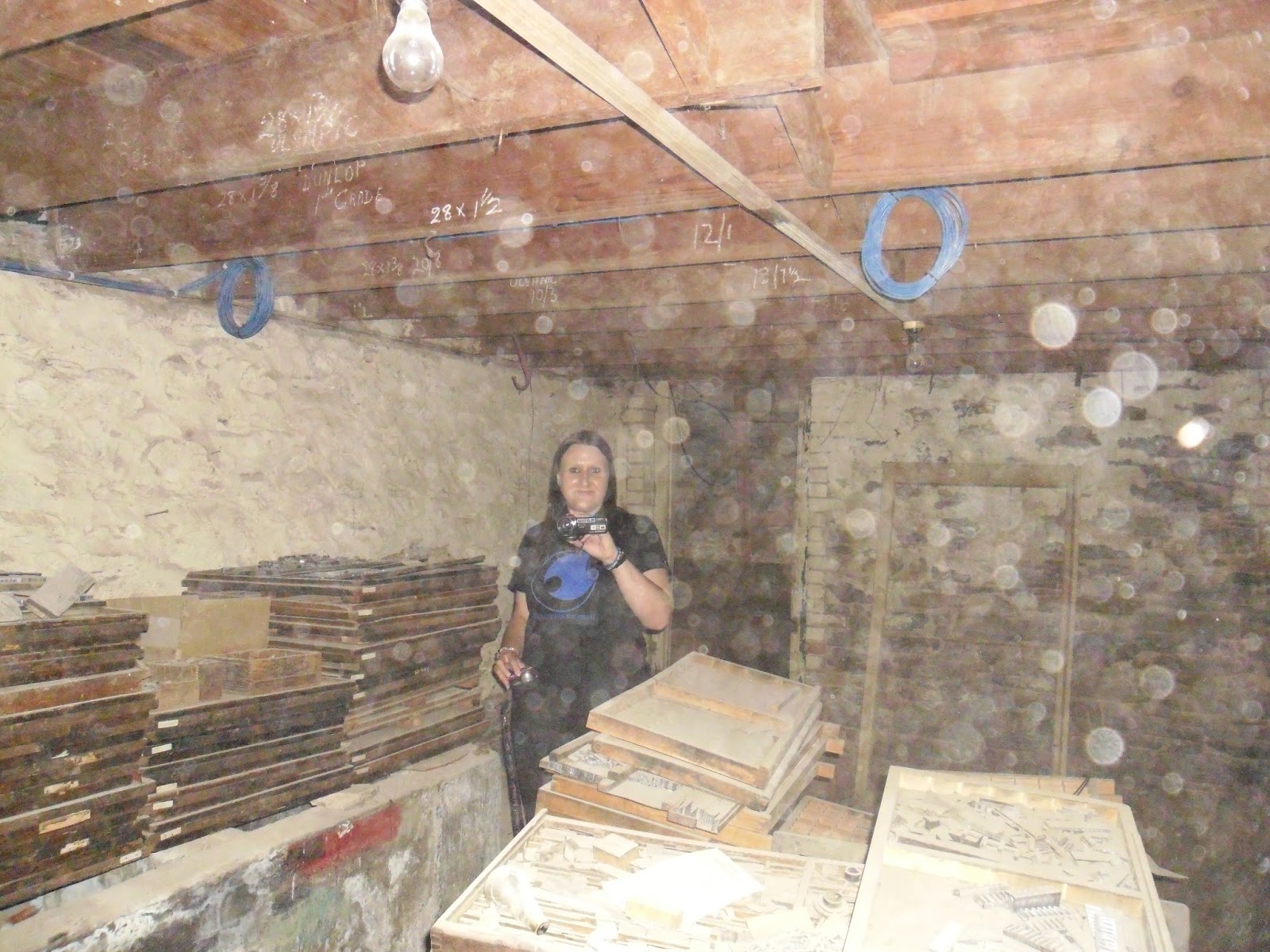
Karen and I were lucky enough to be invited by the newspaper's General Manager, Margaret, to investigate the Bunyip office and printing area. We had a tour of the location including the cellar, which still contained a lot of the old printing tools from the beginning of the 1900s. We also found another room adjacent to the basement that had long been sealed off, no doorways were visible into the room from the old hole in the wall through which we were looking, so we do not know exactly what the rooms use may have once been.

Karen in the Basement
The majority of the phenomena reported to us seemed to be taking place upstairs in the offices. We headed upstairs and started recorded a number of EVP's, with questions tailored to the research we had previously undertaken.
 We heard a couple of loud knocks during our EVP session, but they did not appear on the audio recordings, in their place, however, was low pitch sounds of a dog barking, which no-one in the room with us heard at the time.

The other allegedly active area was a downstairs office, where chairs had moved by their own volition and the sounds of someone sitting at a desk writing had been heard by numerous witnesses. This was intriguing, but on this occasion, we didn’t manage to capture anything on video or audio we would deem as paranormal in origin.

Perhaps the most intriguing alleged paranormal phenomena were the sounds of someone walking up and down the staircase in the centre of the building. Witnesses to this phenomena went to inspect who else was inside the building with them only to find the place securely locked down, and no one else inside!
  Through rigorous debunking, we ruled out the expansion and settling of the wood of the staircase and that of the building. We conducted a number of experiments to try and recreate the reported sounds, with no success. It would seem the person (or Ghost) that is responsible for the noise has some large heavy boots and really wants to be heard, but not seen!


© 2013 Allen Tiller


Tuesday, 5 February 2013

The Old Spot Hotel: The Ghosts of Gawler, Part Three


The Old Spot Hotel

The Ghosts of Gawler Part Three


Gawler's oldest hotel, The Old Spot Hotel was known as the “Golden Fleece Hotel” when it first opened its doors on April 1st 1840 (and has now returned to its original name).

It originally consisted of a one-room hut, a bedroom and a tent, and was Gawler's very first building.
A drawing of the Hotel in 1845
It saw three distinct rebuilds over the years, from being two rooms and a tent into a single-story structure featuring a billiard room (which still stands today).
In 1903 the hotel was rebuilt as a two-story structure. In 2012, new building works began, where shops on the northern side of the hotel were demolished to make way for a reworking of the hotel and its surrounds.

The original publican was one David Scheibener, who eventually saw the inside of the Adelaide Gaol for money owing to Francis Dutton, the hotel was then sold on to its next proprietor.
In its early days, the back section of the hotel was also used as Gawler's first morgue until the construction of better facilities on Todd Street.

The Old Spot in 1890
The Hotel has seen a number of deaths inside its walls. In 1868, Charles Donaldson a 35-year-old local passed away in the hotel.
In 1889, a serious accident occurred directly in front of the hotel when an 8-year-old boy hitched a ride on the horse-drawn tram which ran the middle of Gawler's main street.
 The boy jumped on the back of the tram, but was spotted by the guard and told to get off.
 He jumped off without looking and landed under the hooves of horses pulling a cart. The wheels of the cart ran over his head, crushing it.
The boy's father, working just across the intersection witnessed the grisly accident. A pool of blood sat on the road, near the entrance of the hotel until late the next day.

A horse-drawn tram in 1915 - Old Spot Hotel in the background
The most notable of all ghost stories associated with the pub has been from much more recent times, in approximately 1993, Scott Pearson, a professional photographer took a photo in the hotel that showed three distinct images, thought to be spirits that were haunting the hotel.

The hotel had just had renovations completed and a number of patrons and staff had started to see apparitions of a small girl and older gentlemen. Noises were being heard, voices, and other strange phenomena.
Mr Pearson stayed overnight in the hotel, and set his camera up, taking many photos during the night, only one photo showed anything of interest. You can find the photograph at http://www.castleofspirits.com/website/old/Australianghosthunters/oldspothotel.html and decide for yourself if you think Mr Pearson did indeed capture something paranormal.

© 2013 Allen Tiller


Tuesday, 29 January 2013

Dead Man's Pass - The Ghosts Of Gawler: Part Two


Dead Man's Pass

The Ghosts of Gawler: Part Two


The Para-Pass, as it was known in 1837, has long been a notoriously haunted location in Gawler, South Australia (about 40 mins north of Adelaide).

I grew up nearby in Gawler South and spent a lot of my time as a child playing in the reserve around Dead Man's Pass, collecting tadpoles, sailing boats through the streams, and discovering caves and other hidden secrets throughout the area. I was also intrigued by the endless ghost stories I heard over the years from other friends who used to play there as a kid.

The area was first used as a crossing point for Bullock dray teams, carting goods from northern outposts like Kapunda, it was a good place to camp also, refill water supplies and have a break under the shady trees. Colonel William Light passed through the area, as did many other famous explorers.
 The crossing got its name after an exploration party returning from the Barossa ranges came across an exhausted traveller, whom they offered respite too. Once stopped at the crossing they checked on their new companion who had fallen asleep in the back of their dray, only to find him dead.
 Having no tools with which to dig a grave, they placed his body upright in a hollow tree and covered it as best they could with sticks and branches.

Not long after, another travelling party happened across the gruesome site, and, after taking samples of the gentleman’s clothing, encased him with clay in the tree.

A Sign at Dead Mans Pass - Photo by Allen Tiller
The name “Dead Man’s Pass” was adopted in 1842 as the permanent name of the South Para River ford where the hollow tree coffin was located.

 Before European settlement, Dead Man's Pass and the Gawler region were the home to the Kaurna Peoples, Australian Aboriginals who used the area for hunting food, shelter and water. There are numerous caves hidden throughout the location, some containing Aboriginal paintings.

The area has seen much death, in 1927 there was a swinging walk bridge installed across the river, a Mr J Bald, a local man, leaned over the side of the rope bridge, and nearly severed his head when he slipped.

In 1901, Patrick Condon, a Gawler Corporation employee had a fatal accident where his night cart flipped when it fell down an embankment, and landed on him, killing him.

Also in 1901, a young boy, who was also crippled, was found dead in a billabong. Anton Johann Linke's clothing was found on the banks by another young lad, who went to search for him, only to find Anton floating in the water, dead.
Do any of these people now haunt the location? That we cannot say, however, a number of other ghost stories have surfaced over the years.

There are many stories of paranormal encounters at Dead Mans Pass. If one cares to visit the “Ghost Village” website, one can read the story of a young man and his mate who were riding their bikes down First Street. They were going too fast, and one kept hearing a voice in his ear say “go right!” indicating to turn right into Gawler Terrace.
 The boy didn’t have much time to make a choice, if he swept left around the Dead Man's Pass bend he would go into oncoming traffic, if he managed to turn right, he wouldn’t make the turn.
 Going against his instincts, he turned right, and ploughed straight into the curb, flying through the air, and hitting a massive gum tree.
 He lay there stunned.  He looked up and saw two figures standing over him. A man and a woman. The man said, "You're lucky to be alive, lad," and the Lady said, "Take heed, boy, you only get one chance like this!"…
The boy's mate came over to see if he was ok. Laying on the ground, without a scratch on him, he asked his mate where the old people had gone. His mate replied that he hadn’t seen anyone, but he had heard his friend talking to someone. He then said he had watched him fly through the air, over 33 feet of gravel, and then land, almost softly on the big gum tree. ( read the entire story here: http://www.ghostvillage.com/encounters/2006/10022006.shtml ).


Another more recent story involves seeing a woman, in period clothing standing near the back of the Ambulance station. This is a personal experience story that may appear later in another publication on this blog if the witness is prepared to offer it.
Allen with other S.A. teams in Dead Man Pass
Recently, I was down in the Pass myself, showing some other paranormal teams around the place who had never been there before. As we were walking through, one team noticed something odd, and began filming, what appears on the video is a younger person hiding in the bushes watching us, we don’t believe anyone else was there at the time, at least not in the exact location we were, which was very far in the reserve, and no-one left while we were there over the next few hours. Was it a ghost? Well of that we are uncertain!

 Dead Man's Pass remains a mysterious place, but not one to wander in to at night alone, due to dangers with the living more so than the dead!

© 2013

Allen Tiller

www.eidolonparanormal.com.au

Tuesday, 22 January 2013

Spring-Heeled Stephen - The Ghosts of Gawler: Part One


Spring-Heeled Stephen

The Ghosts of Gawler - Part 1


In 1941 Gawler, Angaston, and the Gawler River area were under the intimidation of a particularly violent ghost, who was making itself known to young women and children.

Making his first appearance at Gawler River in a lonely farmhouse, the ghost “played spooks” around the outhouses of the farm until he awoke a young farmhand who chased him down and threatened to hit him.


 The ghost duly melted away into the night, but he returned later and was found in the house after a number of children awoke screaming that they had seen a ghost in the room.

 The ghost jumped through a window to make his escape!

Spring-heeled Stephen's next haunting was at parkland's in Willaston, just north of Gawler, where he chose to attack more young ladies who were out enjoying the evening. Reports of his ghostly attacks grew, and soon the young ladies of Gawler and Willaston were too afraid to go out at night.

The ghost soon appeared at another well known haunted location, the Old Spot Hotel in Gawler's main street (now the Golden Fleece Hotel). 
A young lad, who was sleeping in his cot outside on the balcony, was seized by the ghost and violently dragged out of bed. The boy, yelling and fighting woke his father, who looked for the attacker but found nothing.


Don Liddy, then owner of the Old Spot, released his Alsatian dog.

  The dog tried to track the ghost, but to no avail, he seemed to have disappeared into the night. Later the same evening, the ghost returned once again and was seen peering in the bedroom windows of the Hotel.

Spring-heeled Stephen made many appearances around Gawler in 1941 but faded in oblivion not much later...

© 2013 Allen Tiller

Tuesday, 15 January 2013

Skeletons on Rundle Street - Sir Arthur Conan Doyle


Skeletons on Rundle Street


Sir Arthur Conan Doyle
Sir Arthur Conan Doyle and the Reverend H. Howard first met each other on-board a P&O boat, en-route to Fremantle, Western Australia. 
The subject of ghosts came up, as it often did with spiritualists and paranormal investigators. During the conversation, a story surfaced about a real human skeleton photograph taken in Rundle Street, Adelaide.

  Mrs McElwin, a lady of Adelaide, was asked if she could find a copy of the photograph and have it sent forward to Mr Doyle for him to peruse and speculate over.

  There were, in fact, two human skeletons in Adelaide on display. Both skeletons were for sale at the time that Mrs McElwin began searching for the photograph of one to send to Doyle. Whether she found the photograph is unknown. What is known is that one of the skeletons could be found in the store of Kuhmels Piano Emporium at 134 Rundle Street in Adelaide
Although Kuhmel's was primarily a music business, he did on occasion sell items for other people. In this case, an articulated human skeleton (a real human skeleton) was for sale via a relative, who had two such skeletons in his possession. The other human skeleton was for sale in a suburb outside of the Adelaide City centre.

It is not known what happened to either skeleton, but during my research, we discovered these were not the only two human skeletons for sale in Adelaide!
Adelaide city of bones?


© 2013 The Haunts of Adelaide 
Written and researched by
Allen Tiller

All content on the “The Haunts of Adelaide” site, blog and corresponding media pages (eg Facebook, twitter etc) is copyright. Apart from any fair dealing for the purpose of private study, research, criticism or review, as permitted under the Copyright Act, no part may be reproduced by any means or process without the written permission of the author. © 2013

All photos remain the property of their respective copyright owners and are displayed here for the purpose of education, research and review under the copyright act "fair usage" clause.