Showing posts with label spooky. Show all posts

Tuesday, 5 December 2023

Ghostly Gawler - History Month Presentation 2021


Ghostly Gawler


As part of the South Australia History Festival, paranormal historian Allen Tiller presented a talk on ghosts, hauntings and other paranormal events in the Town of Gawler for the Gawler History Team. 

Tuesday, 11 October 2022

Angle Vale Road Ghost

 Angle Vale Road Ghost 

- Angle Vale South Australia


Recent reports have come in regarding the sighting of the ghost of a man walking his dog on Angle Vale Road, Angle Vale.
 Witnesses have been driving along Angle Vale Road at dusk, and sometimes late at night when seeing the alleged ghost. The man and dog are walking in the middle of the street. He appears solid but vanishes before the witnesses’ eyes.

If you have witnessed this ghost, we would like to hear your story… please contact us.


An Update (19/10/2022): Since sharing this story of the ghost of a man walking his dog on Angle Vale Road, I have been contacted about the same, or a similar ghost, seen on Dalkeith Road....

Tuesday, 28 June 2022

A Shot of Spirits: Ep 18. Richmond Bridge Tasmania


A Shot of Spirits: Ep 18. 

Richmond Bridge Tasmania


A Shot of Spirits: Ep 18 - Richmond Bridge, Tasmania. Rumoured to be haunted by a former convict flagellator, a dog and a mysterious man wearing a boatman hat!

Tuesday, 1 February 2022

A Haunting at the Royal Adelaide Hospital

 A Haunting at the Royal Adelaide Hospital


The foundations for the Royal Adelaide Hospital (now Lot 14) on North Terrace were laid in 1840, but it took until 1855 for the construction of permanent buildings to begin. These new buildings took a year to complete and contained a surgery, dispensary, nurse’s dining room, chapel, and a surgeon’s quarters.  A two-story building was also constructed which featured inside it, padded cells and bedrooms.

A ghost story from the RAH comes directly from a nurse who was wrapping up a long night shift. The nurse was nearing the end of his shift and was running through the checklist of things to get done before the next shift started. He was tending to a patient who had just been pronounced deceased by the attendant doctor. The nurse washed the deceased man, completed the associated paperwork, then headed into the nurse’s station to await shift change.
  While sitting at the station waiting for the shift to change over, he felt like he was being watched, then noticed a dramatic drop in the temperature of the room. He looked towards the doorway, and saw, standing there, the deceased patient he had just washed. The man was fully dressed, with a big smile on his face, and was waving, as if to say “Goodbye” to the nurse.
  The nurse blinked his eyes in disbelief, and the man was gone... The nurse got up from his seat, ran across the hall into the room where the dead man’s body lay... and there he was, still laid out, still under his blanket, still deceased...

  The RAH also has a story about a ‘Grey Nurse’ the story is the same as it is in most hospitals worldwide. No one really knows who she is, but the Grey Nurse does her duties in death, much like she did in life, delivering comfort to the dying. Could it be that these “Grey Nurses” are Angels from God, sent to comfort the dying? 


© Allen Tiller 2022
(paranormal experiences are directly from the source)

Thursday, 12 September 2019

Hotel of Haunted Dolls - OCT 2019


Hotel of Haunted Dolls


After a successful debut, “When the Lights Go Out Paranormal” returns with another “Hotel of Haunted Dolls” at the ‘Tea Tree Gully Heritage Museum’ Old Highercombe Hotel (3 Perseverance Rd, Tea Tree Gully SA 5091) on the
Saturday 26th Oct 2019 – 10 am until 9 pm
Sunday 27th Oct 2019  - 11 am until 4 pm

At Their first Haunted Dolls Museum, Karina Eames and James Larson flew in special guests, Evelyn and Kerry Walton, and their internationally famous haunted doll ‘Letta Me Out’
( https://www.facebook.com/Letta-me-out-630776097073363/ )  to accompany her haunted dolls collection. The first event saw over 1000 people attend this unique and terrifying event. With one-woman reporting being scratched by an unseen hand, and many others feeling spooked at this creepy-cool event!
This time, Karina’s haunted dolls are the stars of the show for this Halloween Spooktacular event!
 Among the haunted dolls on display at this special event are three new haunted dolls; a new “Grave Doll” a “Minerva Tin Head Doll (1800's)” and ‘Tuppence’ a doll found in a basement in Moonta, which had been given a burial. When retrieved Tuppence new owner began to experience paranormal phenomena such as hearing a child giggle, toys left out in strange places, disembodied footsteps in a passageway…and he even witnessed a ghostly child’s figure…

When The Lights Go Out Paranormal: https://www.facebook.com/pg/whenthelightsgooutparanomal
CONTACT: whenthelightsgooutparanormal@gmail.com
Karen Tiller, Evelyn Walton, Kerry Walton, Karina Eames, 'Letta Me Out' (on Karina's lap), James Larson, Allen Tiller
front: Bowdie-Jason Ciro Papagni at the first; "Hotel of Haunted Dolls"

Previous Media Releases:
This Morning (ITV - UK TV) - https://www.youtube.com/watch?v=TCnxmFDbFiA

Tuesday, 11 June 2019

The Grey Ghost of Port Wakefield


The Grey Ghost of Port Wakefield 

  In February 1918, fear gripped the small town of Port Wakefield as a mysterious apparition, dubbed the Grey Ghost, began appearing throughout the district. For an entire week, the strange figure terrorised residents, leaving a trail of frightened witnesses and increasingly bizarre reports.

  The first sighting occurred on a Monday night at approximately 9:30 pm, when the apparition was spotted between the railway line and Smith’s Corner. A young woman returning home became the first known victim of the mysterious figure. As she walked along the street, the ghost approached her and calmly asked, “How are you?” Terrified, she hurried home and collapsed as soon as she was inside.

Around 10 pm that same evening, a young man returning from a fishing trip had his own frightening experience. As he passed a large haystack, a figure at least seven feet tall emerged from within the baled hay. The apparition let out a series of low, rumbling moans, sending the young man fleeing home, where he promptly locked the door behind him.

The following evening, a young couple walking home encountered the ghost under even more alarming circumstances. A cold hand suddenly touched their heads, turning them toward the apparition and forcing them to look directly into its eyes. Standing at least seven feet tall and shrouded in a fine mist, the figure was a terrifying sight.
The young man abandoned his companion, scrambled over a nearby fence and disappeared into the night. His companion screamed and raced to the nearest house, forcing her way inside before locking the door against the unwelcome visitor.

By Wednesday, tales of the Grey Ghost had spread throughout the town. Two young men decided they had had enough and took it upon themselves to capture the mysterious intruder. Armed and prepared for a confrontation, they waited for the apparition to appear.
After two hours, their quarry finally arrived. According to their account, the ghost rose from the ground before approaching a nearby horse. The animal appeared to fall under its spell, collapsing to the ground and becoming unconscious. The apparition then passed over several walls and fences before disappearing into an old quarry.

The two would-be ghost hunters considered following it but ultimately decided against descending into the disused quarry, preferring not to risk their lives in pursuit of the mysterious figure.

On Thursday night, two men passing near the quarry were engaged in a heated discussion about Russia when they suddenly realised they had company. Standing beside them was the seven-foot Grey Ghost, its clothing resembling swirling smoke. They abandoned the area, and the two men promptly fled in opposite directions, reportedly reaching their respective homes in record time.

Friday night brought little relief. The summer heat made sleeping indoors unbearable, prompting one local man to settle down on his veranda for the night. In the middle of the night, he awoke to discover the Grey Ghost standing just beyond his picket fence.
The apparition made strange gestures towards him while groaning loudly. The startled man wasted no time retreating indoors, where he locked the doors and windows.

Despite the different circumstances surrounding each encounter, witnesses consistently described the apparition in much the same way. It was an imposing figure, standing somewhere between seven and eight feet tall, with terrifying eyes and a grey, mist-like appearance. It reportedly emitted a pungent stench, produced deep, rumbling moans and seemed capable of passing through or climbing over walls and fences with remarkable ease.

For an entire week, the Grey Ghost of Port Wakefield had kept the townsfolk on edge. But the mystery was eventually solved, not by the armed men who had hunted it, nor by the frightened residents who had encountered it, but by a young boy riding his bicycle home.

For nearly a week, the Grey Ghost of Port Wakefield had kept the townsfolk in a state of fear. Despite several sightings and an attempt by two young men to capture the mysterious figure, its identity remained a mystery.

The explanation came when a young boy riding his bicycle home accidentally collided with an old grey horse feeding beside the road. Startled by the impact, the animal reared onto its hind legs, striking out with its front legs and threatening both the boy and a nearby fence before bolting into the night.

The encounter offered a possible explanation for the strange sightings that had plagued Port Wakefield. The horse was grey, reportedly smelled foul, and could reach an imposing height when rearing onto its hind legs. Seen in the darkness, its unusual movements and towering silhouette may have been enough to convince frightened witnesses that they had encountered something supernatural.

However, the precise timing of the boy’s encounter is unclear. While the sightings had occurred over the preceding week, the available account does not establish exactly when the horse was identified or confirm that it was responsible for every reported incident.

The Grey Ghost may, therefore, have been nothing more than an old horse roaming the streets of Port Wakefield after dark. Yet the story leaves us with an intriguing question: did a frightened animal give birth to a ghost story, or were the townsfolk witnessing something they could not quite explain?


Researched and written by Allen Tiller © 2019


Bibliography

1918 'More " Ghost" at Port Wakefield.', The Areas' Express (Booyoolee, SA: 1877 - 1948), 15 February, p. 3. 

1918 'A "Ghost" at Port Wakefield.', Burra Record (SA: 1878 - 1954), 13 February, p. 4. 

1918 'More "Ghost" at Port Wakefield.', The Wooroora Producer (Balaklava, SA: 1909 - 1940), 14 February, p. 3. 

Tuesday, 30 April 2019

Ghosts of the Barossa Valley: Old Freemason's Lodge

Ghosts of the Barossa Valley: Old Freemason's Lodge


 Angaston’s first public library was founded in 1856. Due to its small size, it was found inadequate by locals who needed space to read and learn. A meeting was held in town, and it was decided a Mechanics Institute would be built. The local Oddfellow’s society of the ‘Loyal Park Lodge, Manchester Unity of Oddfellows’ (founded in Angaston on Dec 14, 1855) was also in need of bigger premises. The Oddfellow’s put a motion forward that they would like to pool their monies with that of the Mechanic Institute and build one large building to meet the needs of everyone.

A ‘Mechanic’s Institute’ is an archaic term used to describe a ‘working-class’ place of learning. In the late 1700s, early 1800’s, “mechanic” was anyone who worked as a tradesperson, craftsperson, artisan, and was generally working-class people. They were dubbed ‘poor man’s universities’ and later became known as trade-schools.

Mr G.F. Angas donated land, and a large two-story building was erected. It contained a library, a reading room on the upper floor, a school in the basement and a large room on the ground floor for the Oddfellow’s Lodge, and a large institute hall. The building was officially opened by J.H. Angas in 1870.

Over time, the library moved from the top floor into the basement. Other sections of the building were used as a Sunday School. Balls were held in the hall, the basement was used for meetings, flower shows, weekly dancing and elocution recitals. An upstairs room was utilised by local barber Tom Dawson, after losing his premises in a fire.

 In 1905, The Barossa Masonic Lodge No. 49 received its official warrant, and in 1907, raised the funds to buy the entire building. The Loyal Park Lodge Oddfellow’s, under a previous agreement, reserved its right to use its original lodge room. The front of the building was redesigned by the Freemason, and a new inscription applied which read “Masonic Hall 1910”.

Today the old Freemason Lodge is a bed and breakfast.

 There has long been a rumour that this building is haunted, but the story is a very weak one with almost no evidence. It contains just two lines which were dug out from a very old book no longer in print:

“It has been noted that a figure is often seen leaving the Hall and crossing the street, simply disappearing before spectators’ eyes as his feet hit the pavement on the other side of the road”


 Researched and written by Allen Tiller © 2019

Bibliography

Chinner, B., & Berry, P., ‘Angaston sketchbook’, (Rigby Adelaide 1976).

Baragwanath, P., ‘Mechanics’ Institutes role in Australia’s history’, The Guardian: The Worker’s Weekly, Vol.1526, (9 November 2011), https://www.cpa.org.au/guardian/2011/1526/12-mechanics-institutes.html, accessed 18 April 2019.

1936, Angaston and Nuriootpa: centenary souvenir, 1936, The Leader, Angaston viewed 18 April 2019, http://nla.gov.au/nla.obj-21483483

Tuesday, 18 October 2016

The Haunting of the Lyndoch Hotel


The Lyndoch Hotel

 For a short while, many years ago, I lived in the town of Lyndoch in the Barossa Valley. I discovered a few local ghost stories by chatting with the locals the most common story amongst the people I spoke to was to do with the “projectionist ghost” of the Lyndoch Hotel.


The Lyndoch Hotel is located on Gilbert Street, at the intersection with Barossa Valley Way and Lyndoch Valley Road.
 The hotel was originally opened in 1869 as the “Farmers Rest Hotel, until it was later known as the “Travelers Rest Hotel” until it was renamed in 1937 with its present moniker.
 The original building was gutted by a fire with the building we see today constructed later that year.


It is believed that the former lessee of the Lyndoch Cinema, Mr J.A. Morcom, who played movies in the local hall for many years, is of the resident spirits of the hotel. Mr Morcom passed away in the hotel. It was a regular occurrence for him to spend the night in the hotel after a movie night.

 EDIT: I was informed during the Barossa History Fair (2019) that this part of the story is actually wrong: 

"On the 14th of February 1959, Mr Morcom passed away after taking his own life in his regular room, room 8. He had grown very sad and disheartened after the death of his wife, and in the end, his sadness overcame him.
 He left a suicide note and a photo of his wife, his note read “Sorry, there’ll be no movies next Saturday”.

The true story is; 
 Mr Morcom had never married and died from a heart attack.

 This incorrect part of the story came from the book "True Barossa Ghosts" and is repeated verbatim on the Lyndoch Hotel website. My apologies to Mr Morcom's family and friends for publishing information that has proven to be incorrect. Perhaps, with the truth now exposed, Mr Morcom's spirit might find some peace.

Mr Morcom's alleged ghost: 

A man staying in room 8 witnessed Mr Morcom in his room, and ever since patrons and publicans have encountered his spirit in the hotel, with visual sightings of him a regular occasion.

 He is described as looking like a “middle-aged man, rather thin, and dressed in a grey shirt and slacks”.
 Bedroom 8 was removed in a renovation of the hotel, but Mr Morcom is still seen where he once stayed every Saturday. Where once he was seen in room 8, he is now seen standing behind a bar.

Mr Morcom’s story was not the only one I heard about the hotel in my time in the town. 


Another ghost is thought to be a local who spent many years drinking at the bar. Like most barfly’s, he had a seat that was his favourite. After his death, I am told it was a regular occurrence for his barstool to move of its own accord, and a few seconds later for the male toilet door to open of its own accord as if someone was entering the loo!

 Was this ghost drinking, and following his old toilet ritual as he did when he was alive, is it just pure coincidence, or is there a natural explanation?

 Have you experienced the “Projectionist Ghost” at the Lyndoch Hotel? I would love to hear your story!


 Email Allen Tiller at eidolon@live.com.au
Written and Researched by Allen Tiller.

Bibliography
 “A Brief History of the Hotels of Lyndoch 1847 – 1937” by Anne Hausler, 1991,  is kindly authorised by The Lyndoch & District Historical Society.

Laughton, VJ, 1991. True Barossa Ghosts. 2nd ed. South Australia: Bull Creek Books Tanunda.

Lyndoch Hotel. 2016. Lyndoch Hotel Ghost. [ONLINE] Available at: http://lyndochhotel.com.au/lyndoch-hotel-ghost/#!prettyPhoto. [Accessed 11 September 2016].

Tuesday, 24 May 2016

Haunted Buildings in Adelaide - Adelaide City Council Libraries


Haunted Buildings in Adelaide
Slide from the world first "Haunted Buildings in Adelaide" paranormal history residency


 My regular readers would know, that for the past few months of 2016 (February through to May) I have been engaged by the Adelaide City Council Libraries to be their ‘Historian in Residence’ for the “Haunted Buildings in Adelaide” project.
 The project, which involved the public bringing in their own ghost stories, photos and experiences was incredibly successful and gained a hug amount of media attention for the library and its projects, including coverage on Channel 7’s ‘Today Tonight’, 2 radio interviews on ABC 89.1, radio interviews with Alan Hickey on 5AA, the Y Report on Coast FM, The front page of the City Messenger, as well as newspaper coverage in The Advertiser, The Australian and their respective websites.
 Very soon the research side of the project will surface online on the Adelaide City Council Website, the research will include a brief history (some a little briefer than others) of the building, including the architect, opening date, trivia and other facts, and associated ghosts stories and urban legends.

 Some of the places in the project you may have never heard of before, and some are old stories, with new sightings, there is even a couple of Audio and Video oral histories thrown into the mix.
 Even though my residency in the library has ended, the project has not. This project will be ongoing for as long as there is interest in Adelaide’s ‘alternative’ history. So if you have a ghost story from anywhere in the Adelaide City Council region and you would it like shared, please feel free to email me at eidolon@live.com.au and I’ll have it added to the collection.
 
 As soon as the collection is live, I will be sharing it via my social media and website via the following pages:
Facebook: 
Website: www.AllenTiller.com.au

You can also find the Adelaide City Council Libraries and the History Hub via the following links
Facebook:
 

or pop into the libraries History Hub at Level 3, Rundle Place, Rundle Mall, Adelaide

Tuesday, 15 September 2015

The Haunted Halfway Hotel at Beverly, South Australia

 Halfway Hotel - Beverly


With over 165 years of history, the Halfway Hotel at Beverly is one of Adelaide's longest licensed hotels, with only The Edinburgh Castle in Currie Street serving longer, opening it's doors in 1837.
The hotel has no only been a favourite drinking hole, but accommodation for many weary travellers, immigrants and dignitaries coming into Adelaide.

The hotel got its name from being the halfway point for travellers coming from Port Adelaide into the City of Adelaide.

The hotel has long been rumoured to have ghosts. Reports of strange whisperings, lights switching on and off, alarms sounding when no-one is there, and sightings of a wispy figure floating through the bar. There are even reports of bottles flying off the shelves in the drive-through of their own volition.

Urban legends have grown around this pub, with one being the rumour of a man hanging himself in the cellar. This unreferenced event is the alleged source for all the reported paranormal goings-on in the hotel, unless you talk to former staff and caretakers, who cite a former patron they have named “George”.

George has been reported to have the ability to move large objects, much like a poltergeist. His biggest move was to turn all the kegs in the cellar upside down one night, which was found the following morning by staff.

George is also attributed to disembodied footsteps heard walking through various areas of the hotel. He also loves to move furniture around, rearranging whole rooms.

Although most staff agree the hotel is haunted, George is not known for being evil, vindictive or nasty, but rather he is a jokester and a friendly ghost who likes a little recognition now and then.

©2015 - Allen Tiller

Tuesday, 19 August 2014

Gaol or Hospital? Stories From The Gladstone Gaol: Part IV

Gaol or Hospital?

Stories From The Gladstone Gaol: Part IV


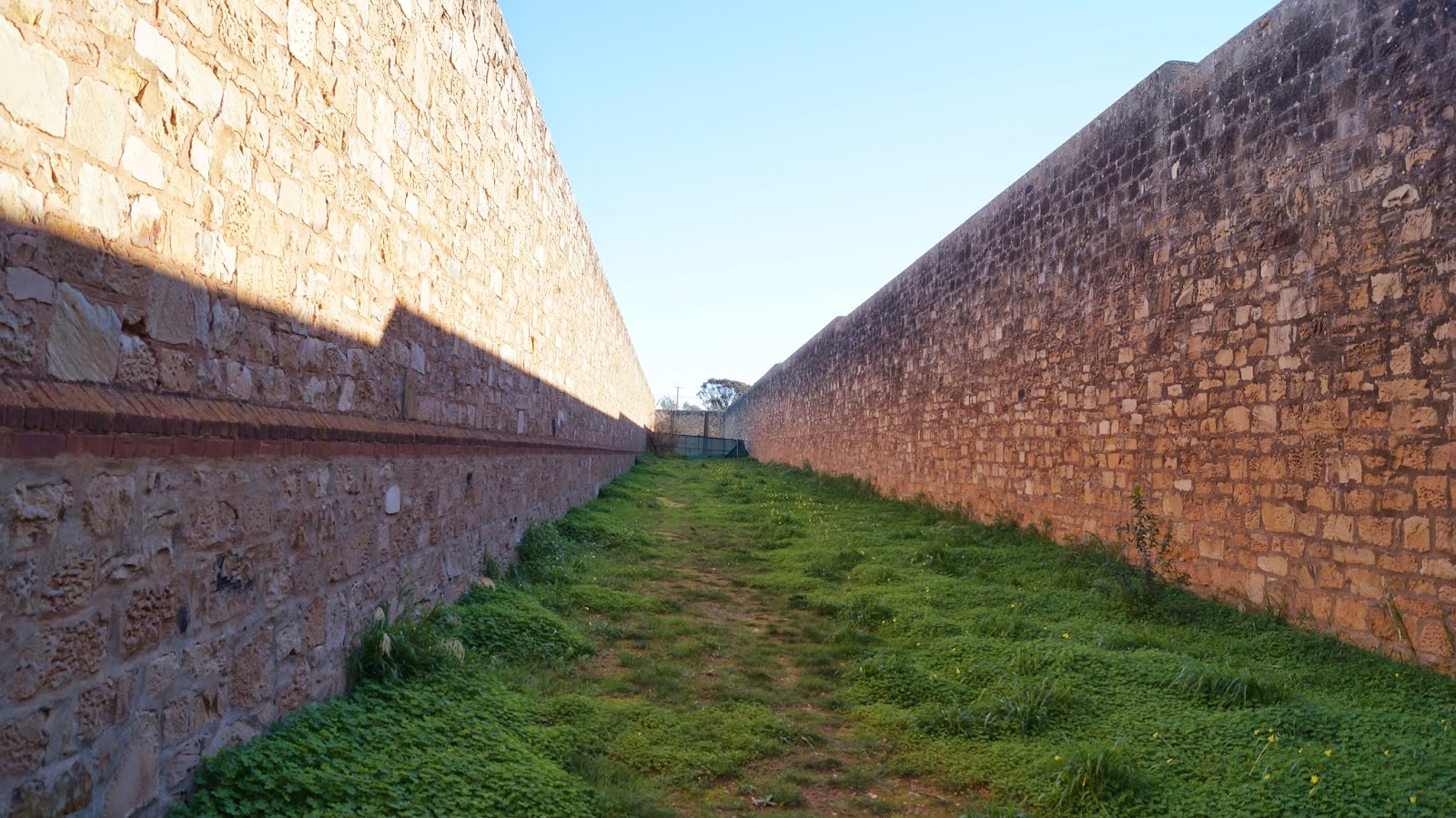
  Gladstone Gaol was built in 1879 at great expense to the colony, and many questioned why such an imposing building was erected in such a remote location. During its many years of operation, it rarely housed hardened criminals, other than those awaiting transfer to Adelaide Gaol. There were no long-term serious offenders kept within its walls. Those serving lengthy sentences were transported to Adelaide Gaol, while Gladstone was used primarily to house drunks, debtors, and other low-level offenders.

Looking down on the inside of the tower
© Allen Tiller

More often than not, however, the gaol housed the sick, the elderly, and the disabled. It became common practice to transfer frail and ill prisoners from Adelaide Gaol and other prisons throughout the South Australian colony to Gladstone to spend their final days. Many were elderly women who would ultimately pass away within its walls.

One such example was reported in the following newspaper article. I also mentioned Eliza Evershed in Part One of this series. She, too, was transferred from Adelaide Gaol and died at Gladstone. It seems to have been a common theme, doesn't it?

The South Australian Advertiser
Tuesday, 1 December 1885 – Page 5

"Caroline F. C. Grahlow, an old woman, died in gaol yesterday. An inquest on the body was held at the gaol by Mr Ingram J.P., Mr Stewart being foreman of the jury.

The evidence of the doctor, matron, and the keeper was taken, and a verdict was returned that death occurred from natural causes.

The woman's age was 65. She was sentenced in Adelaide to four years' hard labour for burning a dwelling-house and had served nearly eighteen months of the term. She had been ailing ever since her arrival here, and a fortnight ago the doctor asked for a remission of the remainder of her sentence owing to her suffering, but the order for her release only came here this morning. Up to the time of her death, she did not acknowledge the crime for which she was sentenced.

Mrs Rofran, sister of the deceased, arrived by train from Adelaide this afternoon with a coffin, and the remains were taken back on this evening's train for interment in Adelaide. It seems that the Government will persist in weeding out all cripples and dying people from the Adelaide Gaol to this one.

Since its establishment, the Gladstone Gaol has been nothing better than a hospital, and many complaints have been made, but to no purpose. It is said that most of the prisoners here are invalids from Adelaide. The case of the poor woman who died yesterday is a most pitiable one and should be enquired into."

Between the walls of Gladstone Gaol
© Allen Tiller

By the end of 1885, little had improved at Gladstone Gaol, as this article from the South Australian Weekly Chronicle demonstrates.

South Australian Weekly Chronicle
Saturday, 19 December 1885

"Another Sick Prisoner from Gladstone Gaol"

"Gladstone, December 16.

A prisoner has been released from the gaol in order to go into the Adelaide Hospital. The poor woman had to be carried into the train this morning. She is utterly helpless and in a pitiable state.

A male and a female warder from Adelaide came for her, and under their charge the prisoner was taken away. Dr Hamilton ordered her removal. This is another instance of sending prisoners here in a frail condition, making this prison an asylum for sick criminals."

Although Gladstone Gaol was built to house prisoners, it appears to have spent much of its existence functioning as a hospital and transfer station for the sick, the elderly, debtors, and inebriates, rather than as a prison for serious offenders.

While there were several escapes over the years, only one escapee was never recaptured. The gaol also witnessed a number of deaths within its walls—but none were the result of execution, riots, medical experimentation, or firing squads.