Showing posts with label mid north. Show all posts

Tuesday, 5 November 2024

A Haunting at Belalie North, South Australia.

 A Haunting at Belalie North, South Australia.


Belalie North is famous as the birthplace of R.M. Williams. It was a town that sprang up when the train line from Peterborough (then Petersburg) to Jamestown was built. It was at the time, the highest train station above sea level in South Australia, which made it hard for steam engines to climb the steep hills. The line was eventually re-routed around Belalie, and the town went into decline.

All that stands today is the ruins of the former general store and the entrance pillars to the town which contain a memorial to local men lost in World War One.[1]

It has long been rumoured that Belalie is haunted. Legend tells of two brothers who fell in love with the same woman. During a heated argument, it is alleged one brother shot and killed the other. Once a year, on the day of the murder, the ghost of the brother, it is said, can be seen standing where he was killed. In a rage, he stands on the road and shouts, ‘I’ll kill you, you bastard!!”


Researched and written by Allen Tiller ©2024


[1] ‘Belalie North,’ Australia For Everyone, (2017), https://www.australiaforeveryone.com.au/files/sa-midnorth/peterborough.html

Tuesday, 24 April 2018

The Devils Garden – Balaklava

The Devils Garden – Balaklava

Commemorative plaque placed on the Devil's Garden memorial cairn, located halfway between Balaklava and Halbury, in the lower Mid North of South Australia along the Balaklava to Auburn Road.
-Photo Source:  27 September 2009 Marionlad

 Balaklava is a small country town in the Mid North, 93km’s north of Adelaide, South Australia. It is situated on the borders of Kaurna and Peramangk peoples land and was first sighted by Europeans in 1840.
 The first European settlers were James and Mary Dunn in 1850, who opened a hotel to service the bullock drays carrying ore from Burra to Port Wakefield. The town proper wasn’t laid out until 1869 when Charles Fisher surveyed the land. The following year the first hotel opened, and from there the town continued to grow.
 7 km’s east of the township, a small reserve, named The Devils’ Garden Reserve, sits almost out of sight of passers-by on the highway. The reserve is a picnic spot, noted for its fine examples of river box gum trees.

 Back in the days of the bullock drays carting copper ore, the area was a treacherous bog in winter and a mountain of hard to navigate sandhills in summer. To address the problem of navigating the area, bullock drays would camp overnight and wait for other teams to arrive. Together they would try to get through the area, helping pull one another from the wintry bogs, or summer sands. This is thought to be how the Devil's Garden became a “place”.

 It was during these camp nights that the ghost was first witnessed. Described as an “unknown male spectre”. It would stand at the top of the sandy hill and scare any bullocks that tried to go over the hilltop. It would also scare men on horses, with some claiming that the ghost would grab the horse’s reins, stopping the horse and rider in its tracks before horse and rider could topple down an unseen cliffside, or become bogged down in impassable mud or sand.

To this day it is not known who the spectral protector was, or why he chose that particular spot to haunt, but he is the reason that the bullock teams named the area "The Devils Garden".

Researched and written by Allen Tiller ©2018
www.allentiller.com.au


Bibliography

Australia For Everyone, 2017, Balaklava, S.A., Pocket Oz Travel and Information Guide Mid North South Australia, viewed 30 Jan 2018, http://www.australiaforeveryone.com.au/sa-midnorth/balaklava.html

Sydney Morning Herald, 2004, Balaklava, The Sydney Morning Herald, Fairax Media, viewed 20 Jan 2018, http://www.smh.com.au/news/south-australia/balaklava/2005/02/17/1108500204142.html


1984 'THE PLAYERS Producer Est. 19[?] BALAKLAVA, B.A.', Victor Harbour Times (SA : 1932 - 1986), 4 April, p. 50. , viewed 30 Jan 2018, http://nla.gov.au/nla.news-article185633892

Tuesday, 18 August 2015

Ghost Trains: Saddleworth, Hawker, Marree.

Ghost Trains: Saddleworth, Hawker, Marree.


Saddleworth Ghost Train:

Many years ago, the Saddleworth train station was a busy railway facility in the mid-north of South Australia. A transport hub for wheat and other grain to travel by train interstate, or to Port for international shipments.
As time went by, the station saw less and trains stopped, and eventually, the station became abandoned. It stood abandoned for many many years, visited only by graffiti vandals, Trainspotters...and a resident ghost.

Many people reported seeing strange glowing lights coming from the old station. They seemed to emanate from within the building, but upon closer inspection by witnesses, they would vanish into thin air. With no living soul present, in the building upon inspection, one has to wonder what the lights were – unfortunately, in 2011, the local government took it upon themselves to allow the demolition of the train station... the station is now a memory, as are its ghosts.

Hawker Ghost Train: 
At Hawker, about 365 km north of Adelaide, people report hearing the blare of an old train horn, and the clicking of tracks as an invisible train flies by...the really strange thing is, the tracks were pulled up years ago!

Marree Train Station Ghost: 
Further north (over 600kms from Adelaide ) sits the Marree Train Station. The small town, home to Australia's first Mosque, is very remote and has a population of fewer than 60 people. The train station, long abandoned, features old trains, husks of their former selves.
It has long been reported that the train station is haunted, with people hearing phantom footsteps that shadow their own. A man, possibly a train driver, is sometimes seen in one of the old trains, that sit rusting in the harsh environment.

Have you visited any of these locations and seen a ghost...please visit us on Facebook and tell us your story!

https://www.facebook.com/TheHauntsOfAdelaide
© 2015 - Allen Tiller

Tuesday, 7 July 2015

The Phantom Accident of Lochiel


The Phantom Accident of Lochiel


Last week we took a brief look at the Haunted Ambulance and ghost nurse of Lochiel,< Read it here>  a town located 125kms north of Adelaide, on Highway 1, in the Mid-North region of South Australia. This week we are going to look at another very well-known haunting in the area.


  For many years people have been seeing a car on the side of the road near Lochiel, the car looks as though it has been in a very nasty accident, possibly hitting a tree. Passers-by will look in horror at the car, pull over to help, only to find the vehicle disappear from sight as they approach it.


 This particular accident apparition has been reported for more than 3 decades, and only ever happens during severe weather conditions. Not much has changed about the story over the years, except for one small detail of the stories passed to me, the phantom car has kept up to date with current models – so is this, in fact, an urban legend?


 The stretch of road, Highway 1, approaching Lochiel from Adelaide is notorious for fatal car and truck accidents, and tragically, many people have lost their lives there. In theory, this could be a probable cause for a haunting, as events surrounding deaths of a tragic nature and the emotions surrounding the event could be considered as an explanation for a possible ghostly car sighting – but with that little detail of the car make and model updating as time goes on, it hints that the story is untrue. 


There is always the possibility that there is some truth in the story, and rather than fade from memory, the urban legend has grown thanks to the internet, and internet jokers keeping the story alive. Perhaps this is the case, or perhaps there is an intelligence to the haunting?
 Another theory is that the phantom car could be the image of the latest victims of that stretch of road.
 Have you experienced the phantom car accident near Lochiel? We'd love to hear from you id you have. 

Contact us at eidolon@live.com.au


 May all the people who have met tragedy on Highway 1 Rest In Peace

© 2015 Allen Tiller

Tuesday, 26 August 2014

Gaol Ghosts! :Stories from the Gladstone Gaol - part V


Gaol Ghosts!
Stories from the Gladstone Gaol - part V


If you've been following this blog each week, you'll know I've already covered some of the history of Gladstone Gaol, along with a couple of the deaths that occurred within its walls. This week, I'm going to delve into some of its paranormal mysteries and share a few of my own personal experiences.

Gladstone Gaol is a foreboding presence, perched slightly higher than the rest of the town like a massive crown of cold stone and brick.

Inside its walls, that imposing stone creates an almost claustrophobic atmosphere, cutting you off from the outside world. Standing inside one of the cells and looking through the tiny windows, you can almost imagine the sense of dread the prisoners must have felt as they waited for their sentences to expire.

Of course, most inmates only spent a few months at Gladstone. Serious offenders were almost always transferred to Adelaide Gaol. Even so, being there gave you the overwhelming feeling of being cut off from the world... from life itself.

I first visited the gaol many years ago while following up on some family history research in the area. I wandered through the cell blocks during the day and knew that one day I would return to investigate its reputed hauntings.

That day eventually came, and many more nights have followed since. Like most allegedly haunted locations, however, Gladstone Gaol doesn't reveal its mysteries every time you visit. In fact, this is one place that is very much hit and miss when it comes to paranormal experiences.

Maybe the ghosts just aren't in the mood, or maybe they're off doing other ghostly things—who knows? Whatever the reason, this is one location that certainly doesn't put on a haunting every night.

I consider myself a researcher and a sceptic as much as I am an investigator. Before my team enters any location, I always try to find out what others have reported seeing, hearing, feeling, or capturing. Partly, this is so I can look for logical explanations, but it's also to see whether our experiences match previous reports.

Some investigators argue it's better to go in "cold", without any preconceived ideas. My view is that if ghosts genuinely exist, whether or not you've read previous reports shouldn't make any difference to what happens.

Before my first investigation, I had heard stories of the infamous cold spots in C Wing, reports of an apparition in the main hall, claims of doors opening and closing in A Wing, and countless other alleged paranormal occurrences. To a sceptical mind, many of these can often be explained by perfectly natural phenomena—or, as I like to call them, "xenonormal" occurrences: events that seem paranormal until a natural explanation is found.

My team has now investigated the gaol several times, often alongside other paranormal groups. While we've collected very little in the way of compelling evidence, we've certainly had several personal experiences—some of which we've tried every possible way to debunk without success.

One involved an experiment where we locked volunteers inside the cells while another team leader and I played the roles of wardens. We announced that it was "lights out" and switched off the lights.

In the complete silence of the gaol, we suddenly heard shuffling footsteps behind us.

We both turned and saw what appeared to be a yellow light, about the size of a tennis ball, drift out of one of the cells before disappearing into thin air.

Unfortunately, it occurred in one of the few blind spots in our CCTV coverage, so we couldn't present it as evidence—only as a personal experience.

But it happened.

We spent a considerable amount of time trying to explain what we'd seen. Other investigators attempted to debunk it as well, but none of us could come up with a simple explanation.

What was it?

I honestly have no idea... but at the time, it was certainly exhilarating.

On a later investigation, I decided to point one of our CCTV cameras directly at the same doorway where we'd previously seen the light.

This time, we were investigating with different teams, and it was well into the night. Three of us sat on the cold slate floor watching the monitor while another investigator slowly walked through the cell block.

As she reached the doorway the camera was focused on, the three of us simultaneously saw what appeared to be the figure of a man step out of her body and walk into the room. A moment later, the investigator herself—a woman—walked through the doorway. All three of us jumped to our feet to see what on earth had just happened. The investigator was completely startled by our reaction because she had no idea what we believed we'd just witnessed.

When I reviewed the CCTV footage later, it clearly showed the investigator entering the room and also captured the reactions of the three of us watching the monitor from another camera positioned further down the hallway.

What it didn't show was the figure we all believed we'd seen.

Once again, we tried everything we could think of to explain it, but we never found a plausible answer.

Instead, we were left with nothing but "what ifs".

What if the CCTV had glitched?

What if there was an issue with the DVR frame rate?

What if it was simply an unusual trick of the light?

Of course, we can't present any of these as truths. They remain possibilities—unanswered questions surrounding a single moment in time.

We can remove variables, attempt to recreate the conditions, and search for logical explanations, but we can never recreate that exact moment under exactly the same circumstances.

For me, it remains just that: a fascinating personal experience shared by those who witnessed it.

To this day, I have yet to hear an EVP that truly convinces me, or see a photograph or video that definitively proves Gladstone Gaol is haunted.

That doesn't mean it isn't.

It simply means that, if spirits do reside there, they're either extremely elusive... or perhaps just a little shy.

Either way, I'll keep returning—not only because I enjoy investigating the old gaol, but because I always enjoy catching up with caretaker Tony Holland and wandering through the eerie corridors of one of South Australia's most fascinating historic prisons.

Allen Tiller 2014

Tuesday, 19 August 2014

Gaol or Hospital? Stories From The Gladstone Gaol: Part IV

Gaol or Hospital?

Stories From The Gladstone Gaol: Part IV


  Gladstone Gaol was built in 1879 at great expense to the colony, and many questioned why such an imposing building was erected in such a remote location. During its many years of operation, it rarely housed hardened criminals, other than those awaiting transfer to Adelaide Gaol. There were no long-term serious offenders kept within its walls. Those serving lengthy sentences were transported to Adelaide Gaol, while Gladstone was used primarily to house drunks, debtors, and other low-level offenders.

Looking down on the inside of the tower
© Allen Tiller

More often than not, however, the gaol housed the sick, the elderly, and the disabled. It became common practice to transfer frail and ill prisoners from Adelaide Gaol and other prisons throughout the South Australian colony to Gladstone to spend their final days. Many were elderly women who would ultimately pass away within its walls.

One such example was reported in the following newspaper article. I also mentioned Eliza Evershed in Part One of this series. She, too, was transferred from Adelaide Gaol and died at Gladstone. It seems to have been a common theme, doesn't it?

The South Australian Advertiser
Tuesday, 1 December 1885 – Page 5

"Caroline F. C. Grahlow, an old woman, died in gaol yesterday. An inquest on the body was held at the gaol by Mr Ingram J.P., Mr Stewart being foreman of the jury.

The evidence of the doctor, matron, and the keeper was taken, and a verdict was returned that death occurred from natural causes.

The woman's age was 65. She was sentenced in Adelaide to four years' hard labour for burning a dwelling-house and had served nearly eighteen months of the term. She had been ailing ever since her arrival here, and a fortnight ago the doctor asked for a remission of the remainder of her sentence owing to her suffering, but the order for her release only came here this morning. Up to the time of her death, she did not acknowledge the crime for which she was sentenced.

Mrs Rofran, sister of the deceased, arrived by train from Adelaide this afternoon with a coffin, and the remains were taken back on this evening's train for interment in Adelaide. It seems that the Government will persist in weeding out all cripples and dying people from the Adelaide Gaol to this one.

Since its establishment, the Gladstone Gaol has been nothing better than a hospital, and many complaints have been made, but to no purpose. It is said that most of the prisoners here are invalids from Adelaide. The case of the poor woman who died yesterday is a most pitiable one and should be enquired into."

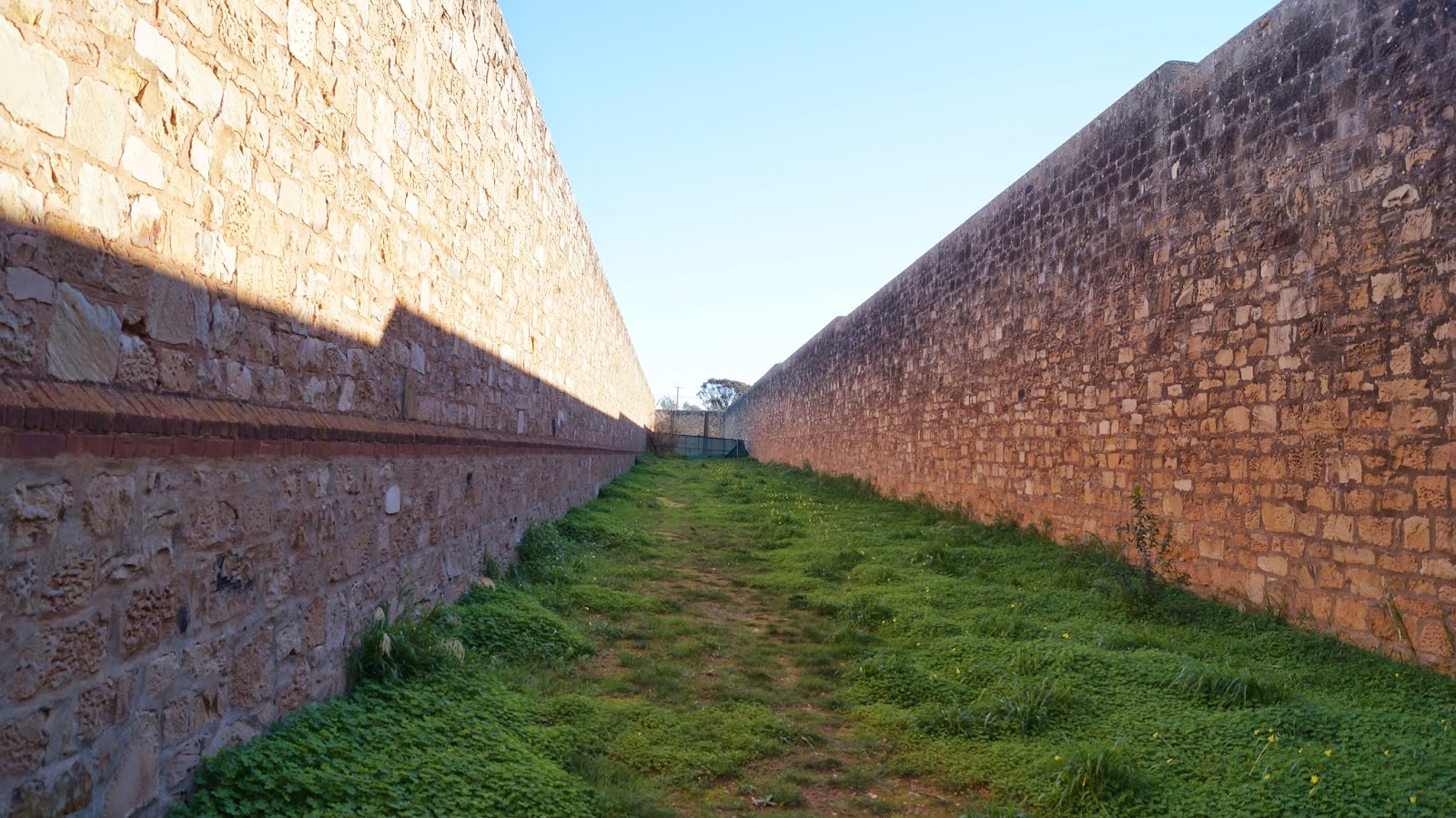
Between the walls of Gladstone Gaol
© Allen Tiller

By the end of 1885, little had improved at Gladstone Gaol, as this article from the South Australian Weekly Chronicle demonstrates.

South Australian Weekly Chronicle
Saturday, 19 December 1885

"Another Sick Prisoner from Gladstone Gaol"

"Gladstone, December 16.

A prisoner has been released from the gaol in order to go into the Adelaide Hospital. The poor woman had to be carried into the train this morning. She is utterly helpless and in a pitiable state.

A male and a female warder from Adelaide came for her, and under their charge the prisoner was taken away. Dr Hamilton ordered her removal. This is another instance of sending prisoners here in a frail condition, making this prison an asylum for sick criminals."

Although Gladstone Gaol was built to house prisoners, it appears to have spent much of its existence functioning as a hospital and transfer station for the sick, the elderly, debtors, and inebriates, rather than as a prison for serious offenders.

While there were several escapes over the years, only one escapee was never recaptured. The gaol also witnessed a number of deaths within its walls—but none were the result of execution, riots, medical experimentation, or firing squads.