Tuesday, 2 September 2014

BATTERED TO DEATH

 BATTERED TO DEATH


  September 3rd 1924, Mrs Henderson, a neighbour of Mr and Mrs Barrowcliffe of O'Halloran Street, Adelaide, went next door to check on her elderly neighbours, who had always been very friendly with her.
  She was surprised when she walked through the unlocked back door to find her neighbours hadn’t gotten up yet, as it was their usual custom to rise early on a Saturday. She entered the bedroom to make sure the old couple were ok and discovered Mrs Barrowcliffe, who was 77 years old, laying on the floor with her head splintered open.
 On the floor next to her was her 79-year-old husband John Barrowcliff, who had suffered a severe laceration to his throat.

  Mr Barrowcliff was still very much alive and whispered to Mrs Henderson “We had a row yesterday. I did it, and after I hit her she never moved."
Mrs Henderson called for help, and Mr Barrowcliffe was taken to the hospital, where he later died from loss of blood.


Police investigated the murder-suicide and determined that at some time in the previous night, Mr Barrowcliff had struck his wife in the head with a tomahawk, splintering her skull and killing her.
He then took a knife from the kitchen and slit his own throat.

The Barrowcliffs had no immediate family in Adelaide, as they had moved from rural New South Wales and had made few friends.

There was no real motive offered for the killing.

Tuesday, 26 August 2014

Gaol Ghosts! :Stories from the Gladstone Gaol - part V


Gaol Ghosts!
Stories from the Gladstone Gaol - part V


If you've been following this blog each week, you'll know I've already covered some of the history of Gladstone Gaol, along with a couple of the deaths that occurred within its walls. This week, I'm going to delve into some of its paranormal mysteries and share a few of my own personal experiences.

Gladstone Gaol is a foreboding presence, perched slightly higher than the rest of the town like a massive crown of cold stone and brick.

Inside its walls, that imposing stone creates an almost claustrophobic atmosphere, cutting you off from the outside world. Standing inside one of the cells and looking through the tiny windows, you can almost imagine the sense of dread the prisoners must have felt as they waited for their sentences to expire.

Of course, most inmates only spent a few months at Gladstone. Serious offenders were almost always transferred to Adelaide Gaol. Even so, being there gave you the overwhelming feeling of being cut off from the world... from life itself.

I first visited the gaol many years ago while following up on some family history research in the area. I wandered through the cell blocks during the day and knew that one day I would return to investigate its reputed hauntings.

That day eventually came, and many more nights have followed since. Like most allegedly haunted locations, however, Gladstone Gaol doesn't reveal its mysteries every time you visit. In fact, this is one place that is very much hit and miss when it comes to paranormal experiences.

Maybe the ghosts just aren't in the mood, or maybe they're off doing other ghostly things—who knows? Whatever the reason, this is one location that certainly doesn't put on a haunting every night.

I consider myself a researcher and a sceptic as much as I am an investigator. Before my team enters any location, I always try to find out what others have reported seeing, hearing, feeling, or capturing. Partly, this is so I can look for logical explanations, but it's also to see whether our experiences match previous reports.

Some investigators argue it's better to go in "cold", without any preconceived ideas. My view is that if ghosts genuinely exist, whether or not you've read previous reports shouldn't make any difference to what happens.

Before my first investigation, I had heard stories of the infamous cold spots in C Wing, reports of an apparition in the main hall, claims of doors opening and closing in A Wing, and countless other alleged paranormal occurrences. To a sceptical mind, many of these can often be explained by perfectly natural phenomena—or, as I like to call them, "xenonormal" occurrences: events that seem paranormal until a natural explanation is found.

My team has now investigated the gaol several times, often alongside other paranormal groups. While we've collected very little in the way of compelling evidence, we've certainly had several personal experiences—some of which we've tried every possible way to debunk without success.

One involved an experiment where we locked volunteers inside the cells while another team leader and I played the roles of wardens. We announced that it was "lights out" and switched off the lights.

In the complete silence of the gaol, we suddenly heard shuffling footsteps behind us.

We both turned and saw what appeared to be a yellow light, about the size of a tennis ball, drift out of one of the cells before disappearing into thin air.

Unfortunately, it occurred in one of the few blind spots in our CCTV coverage, so we couldn't present it as evidence—only as a personal experience.

But it happened.

We spent a considerable amount of time trying to explain what we'd seen. Other investigators attempted to debunk it as well, but none of us could come up with a simple explanation.

What was it?

I honestly have no idea... but at the time, it was certainly exhilarating.

On a later investigation, I decided to point one of our CCTV cameras directly at the same doorway where we'd previously seen the light.

This time, we were investigating with different teams, and it was well into the night. Three of us sat on the cold slate floor watching the monitor while another investigator slowly walked through the cell block.

As she reached the doorway the camera was focused on, the three of us simultaneously saw what appeared to be the figure of a man step out of her body and walk into the room. A moment later, the investigator herself—a woman—walked through the doorway. All three of us jumped to our feet to see what on earth had just happened. The investigator was completely startled by our reaction because she had no idea what we believed we'd just witnessed.

When I reviewed the CCTV footage later, it clearly showed the investigator entering the room and also captured the reactions of the three of us watching the monitor from another camera positioned further down the hallway.

What it didn't show was the figure we all believed we'd seen.

Once again, we tried everything we could think of to explain it, but we never found a plausible answer.

Instead, we were left with nothing but "what ifs".

What if the CCTV had glitched?

What if there was an issue with the DVR frame rate?

What if it was simply an unusual trick of the light?

Of course, we can't present any of these as truths. They remain possibilities—unanswered questions surrounding a single moment in time.

We can remove variables, attempt to recreate the conditions, and search for logical explanations, but we can never recreate that exact moment under exactly the same circumstances.

For me, it remains just that: a fascinating personal experience shared by those who witnessed it.

To this day, I have yet to hear an EVP that truly convinces me, or see a photograph or video that definitively proves Gladstone Gaol is haunted.

That doesn't mean it isn't.

It simply means that, if spirits do reside there, they're either extremely elusive... or perhaps just a little shy.

Either way, I'll keep returning—not only because I enjoy investigating the old gaol, but because I always enjoy catching up with caretaker Tony Holland and wandering through the eerie corridors of one of South Australia's most fascinating historic prisons.

Allen Tiller 2014

Tuesday, 19 August 2014

Gaol or Hospital? Stories From The Gladstone Gaol: Part IV

Gaol or Hospital?

Stories From The Gladstone Gaol: Part IV


  Gladstone Gaol was built in 1879 at great expense to the colony, and many questioned why such an imposing building was erected in such a remote location. During its many years of operation, it rarely housed hardened criminals, other than those awaiting transfer to Adelaide Gaol. There were no long-term serious offenders kept within its walls. Those serving lengthy sentences were transported to Adelaide Gaol, while Gladstone was used primarily to house drunks, debtors, and other low-level offenders.

Looking down on the inside of the tower
© Allen Tiller

More often than not, however, the gaol housed the sick, the elderly, and the disabled. It became common practice to transfer frail and ill prisoners from Adelaide Gaol and other prisons throughout the South Australian colony to Gladstone to spend their final days. Many were elderly women who would ultimately pass away within its walls.

One such example was reported in the following newspaper article. I also mentioned Eliza Evershed in Part One of this series. She, too, was transferred from Adelaide Gaol and died at Gladstone. It seems to have been a common theme, doesn't it?

The South Australian Advertiser
Tuesday, 1 December 1885 – Page 5

"Caroline F. C. Grahlow, an old woman, died in gaol yesterday. An inquest on the body was held at the gaol by Mr Ingram J.P., Mr Stewart being foreman of the jury.

The evidence of the doctor, matron, and the keeper was taken, and a verdict was returned that death occurred from natural causes.

The woman's age was 65. She was sentenced in Adelaide to four years' hard labour for burning a dwelling-house and had served nearly eighteen months of the term. She had been ailing ever since her arrival here, and a fortnight ago the doctor asked for a remission of the remainder of her sentence owing to her suffering, but the order for her release only came here this morning. Up to the time of her death, she did not acknowledge the crime for which she was sentenced.

Mrs Rofran, sister of the deceased, arrived by train from Adelaide this afternoon with a coffin, and the remains were taken back on this evening's train for interment in Adelaide. It seems that the Government will persist in weeding out all cripples and dying people from the Adelaide Gaol to this one.

Since its establishment, the Gladstone Gaol has been nothing better than a hospital, and many complaints have been made, but to no purpose. It is said that most of the prisoners here are invalids from Adelaide. The case of the poor woman who died yesterday is a most pitiable one and should be enquired into."

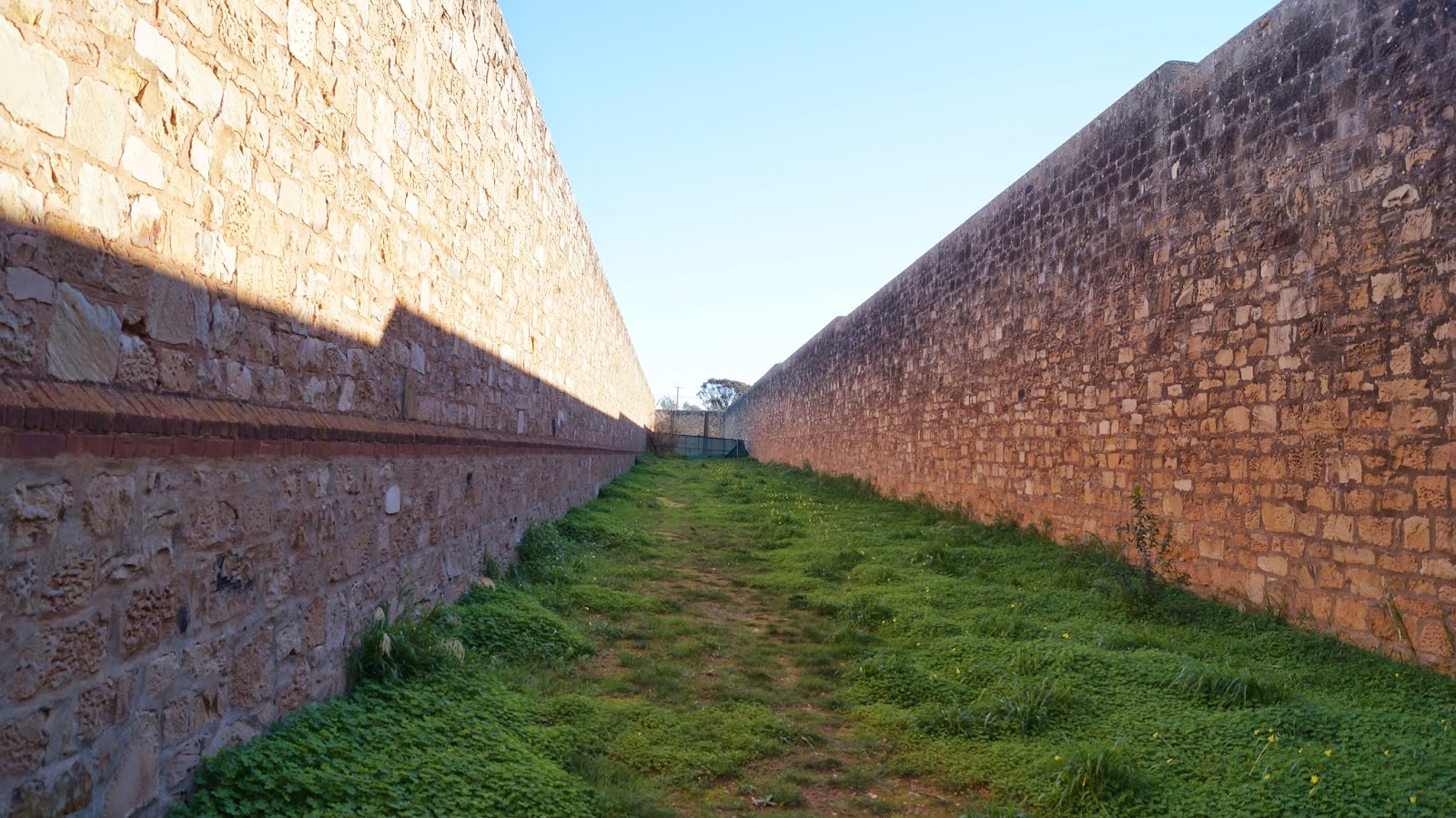
Between the walls of Gladstone Gaol
© Allen Tiller

By the end of 1885, little had improved at Gladstone Gaol, as this article from the South Australian Weekly Chronicle demonstrates.

South Australian Weekly Chronicle
Saturday, 19 December 1885

"Another Sick Prisoner from Gladstone Gaol"

"Gladstone, December 16.

A prisoner has been released from the gaol in order to go into the Adelaide Hospital. The poor woman had to be carried into the train this morning. She is utterly helpless and in a pitiable state.

A male and a female warder from Adelaide came for her, and under their charge the prisoner was taken away. Dr Hamilton ordered her removal. This is another instance of sending prisoners here in a frail condition, making this prison an asylum for sick criminals."

Although Gladstone Gaol was built to house prisoners, it appears to have spent much of its existence functioning as a hospital and transfer station for the sick, the elderly, debtors, and inebriates, rather than as a prison for serious offenders.

While there were several escapes over the years, only one escapee was never recaptured. The gaol also witnessed a number of deaths within its walls—but none were the result of execution, riots, medical experimentation, or firing squads.


Tuesday, 12 August 2014

Experimental Gaol: Stories From The Gladstone Gaol - Part 3

Experimental Gaol:

 Stories From The Gladstone Gaol - Part 3


In late 1953, Gladstone Gaol reopened as a medium-security corrective training facility for offenders aged between 18 and 25.

Looking at the central guard tower - Gladstone Gaol
© Karen Tiller
In 1955, the gaol underwent its first major expansion with the construction of what is now known as "C Block", or the Experimental Wards. The addition increased the prison's capacity to 125 cells. By 1969, the gaol housed around 130 prisoners and processed up to 20 prisoner transfers each day.

The term "Experimental Wards" has often been misunderstood. I have read many outrageous stories that have arisen from the misinterpretation of the word "experimental". The gaol was never "experimental" with its prisoners. There were never prefrontal lobotomies or other medical procedures carried out on inmates. In reality, the term "experimental" referred to the design of the cells themselves.

At the time, no other prison in the world had cells like those constructed at Gladstone Gaol. These cells had no windows and contained a concrete ledge at one end that served as the prisoner's bunk. They also featured an internal ventilation system with air vents designed in such a way that escape through them was impossible.

Looking over the Laundry area from the tower
© Karen Tiller

The entire cell block was built above ground level, as can still be seen from the outside today. This allowed air to circulate beneath the cells, helping to keep them much cooler during Gladstone's scorching summers, when temperatures can easily reach 46°C.

Throughout more than 100 years of operation, there were only 26 escapes from Gladstone Gaol. Only one escapee was never recaptured—an Italian prisoner who reportedly fashioned a master key from a piece of wire and successfully escaped.

The gaol eventually closed in December 1975 due to government concerns that its facilities were outdated. More recently, a former prison officer who worked there during the gaol's final five years has publicly advocated for the facility to be reopened to house lower-security offenders.

In 1979, the gaol welcomed a new group of "prisoners", although these were simply actors filming the Australian movie Stir, starring Bryan Brown. The film, a gritty portrayal of life inside an Australian prison, left behind several props that remain today. These include the daily activity boards mounted on the backs of cell doors and a small museum dedicated to the film within C Block. Several signs throughout the gaol, including one reading "Maximum Security", are also original props from the production.

Movie Prop from the movie "Stir"
©Allen Tiller

Mr Rob Williams was quoted in the regional newspaper The Flinders News as saying:

"It was a very sad, depressing and unnecessary day when the prison closed. It was a ridiculous decision, one that was totally political.

Now, the whole criminal justice system is soft. There is too much emphasis today on the comfort of the offender than there is on the welfare and safety of the victim.

Gladstone Gaol is unique in every way, with its high tapered walls and self-sufficient design. Instead of closing places such as Gladstone and Adelaide Gaol, both should have been kept operational."


References:

The Flinders News

www.trove.nla.gov.au

Tuesday, 5 August 2014

Construction: Stories From The Gladstone Gaol - Part 2

Construction:
Stories From The Gladstone Gaol -Part 2

In South Australia's Mid North, approximately 221 km from Adelaide, sits the town of Gladstone. On Ward Street, on the western side of town, stands the imposing Gladstone Gaol.

The gaol was constructed between 1879 and 1881 at a total cost of £21,640. Its grey slate floors were made from slate quarried at Mintaro and transported to Gladstone by bullock dray.

Many people question why the gaol was built in such a remote part of South Australia, especially so close to where three railway gauges met, offering what many believed would have been an easy escape route.

B Wing - Gladstone Gaol
© Karen Tiller

A story published in The Mail on 8 August 1881 refers to the building of the gaol and also mentions the first female prisoners to be imprisoned there:


8 August 1881 – Gladstone Gaol

On 8 August 1881, two months to the day after it had opened, Gladstone Gaol received its first female prisoners. Sometime before 1879, Charles Mann, MP for the district, was asked by local residents what he could do for the town. He asked them whether they would like a gaol, and two years later, Gladstone Gaol—described by one writer as having "a gloomy solidity"—was opened.

Sunset Through The Bars
© Allen Tiller
Mr Pollett, from the Redruth Gaol at Burra, was appointed head keeper, and the gaol accommodated  60 male and female prisoners. It appears that it rarely held a full complement of inmates, and its only "lifer" was a cat named Lady Jane Grey.

Rumours have long circulated that the Gaol was a political stunt, orchestrated because a former government minister, who later became Attorney-General, wanted to see government funding directed into Gladstone. Whether true or not, the result was the construction of a prison capable of housing 60 inmates in a town with a population of about 900 people.

Because of its distance from Adelaide, the gaol was rarely used for serious offenders. Instead, it primarily housed debtors and inebriates—in other words, people who couldn't pay their bills or who had alcohol-related offences. Much of the time, the gaol stood empty. In fact, when inebriates elected to serve their sentences at Gladstone Gaol, they were reportedly paid an allowance equivalent to £26 per year.

Probably the only time the gaol came close to full capacity was during outbreaks of measles or other highly contagious diseases in Adelaide. At such times, Gladstone Gaol was converted into a makeshift hospital and quarantine station.

During the Second World War, Gladstone Gaol was used as an internment camp for people of Italian and German origin, as well as prisoners of war who were regarded as security risks to the nation. During this period, it also housed soldiers who had gone AWOL (Absent Without Leave) from their military postings.

From 1943 until 1953, the prison stood dormant and empty.


NO ONE WAS EVER HANGED AT THIS GAOL.

Sorry about the capitals, but I wanted to emphasise this point. Despite all the conjecture, rumours, misinformation and local legends, no one was ever hanged at Gladstone Gaol, either officially or unofficially.

Next week, we'll take a look at the new extensions to the gaol!


Allen Tiller (C) 2014


Tuesday, 29 July 2014

The Death of Eliza Evershed: Stories from Gladstone Gaol – part I

The Death of Eliza Evershed

Stories from Gladstone Gaol – part I

On Saturday, 16 September 1882, Eliza Evershed, a prisoner within the walls of Gladstone Gaol in South Australia's Mid North, passed away... her last words: "Goodbye"...

By all accounts, Eliza Evershed had lived a hard life. Her husband, Alfred Batchelor Evershed, had once owned the Maid of Auckland Hotel in Edwardstown, which she eventually ran herself after his death.

No one was quite sure of her age. At the time of her death, she was listed as 65 years old, but doctors proclaimed that she had either lived a very hard life or was at least 80 years old when she died.

Eliza was often in court, on both sides of the law. Sometimes her hotel would be robbed; at other times, she herself would rob people. In fact, she had been incarcerated in Adelaide Gaol on a seven-year sentence for larceny about 12 months earlier. Still, she had been transferred to the lower-security Gladstone Gaol as her health was failing rapidly.

Eliza's character was on full display in 1872 when she appeared in court with her friend, Catherine Mott. Catherine had been charged with stealing a set of scales worth two pounds from shopkeeper Robert Crocker.

Crocker had allowed Catherine into his shop on Grenfell Street to work, but when he returned the following day, the scales were gone.

Catherine requested that Eliza be present, as she was a tenant at the Maid of Auckland Hotel. Eliza took the stand as a witness and declared:

"I am Eliza Evershed, the old woman of the Maid of Auckland. I am a widow, and I am perfectly willing to 'have' Inspector Bee."

The courtroom erupted into laughter, and poor Inspector Bee blushed, embarrassed by the grotesque old woman's antics.

The court ruled that the old woman exhibited "decided traces of real or assumed insanity" and that "no satisfactory evidence could be got from her."

Eliza spent her final days in prison, but she was, in fact, a free woman, having had her sentence remitted on 11 September. However, as she was so unwell, the warden considered it unsafe to move her.

Before her death, Eliza spoke of the kindness she had received from the female warder, Mrs Pollit.

Honorah Dunn, a fellow prisoner, said Eliza had been ailing for some time. Honorah had spent a great deal of time with the old lady, both day and night, over the previous fortnight, helping her with anything she needed. Eliza had everything she required and never complained about the treatment she received. She passed away quietly within the walls of Gladstone Gaol.


© Allen Tiller 2014

Tuesday, 22 July 2014

The Maria Massacre - 25 July 1840


The Maria Massacre - 25 July 1840


  Maria, a 136-ton sailing ship left Port Adelaide headed towards Hobart, Tasmania on the 20th of June 1840, when it was blown off course and floundered at Cape Jaffa on a reef. (near Kingston SE, South Australia)
Maria's passengers and crew consisted of the following 25 people:

Captain William Smith and his Wife.
Samuel Denham and Mrs Denham and their five children (Thomas, Andrew, Walter, Fanny and Anna).
Mrs York (sister of Mr. Denham), who had recently been widowed and her infant.
James Strutt who had been hired as Mrs Denham's servant.
George Young Green and Mrs Green.
Thomas Daniel and Mrs Daniel.
Mr. Murray
The ship's mate and crew:
John Tegg
John Griffiths
John Deggan
James Biggins
John Cowley
Thomas Rea,
George Leigh
James Parsons.

  When the Maria hit the reef, the passengers and crew made their way ashore with the goal of making their way, by foot to Encounter Bay to seek help aide for the now-abandoned ship.
  The party came across local indigenous people and asked them to lead the party to safety. Along the way, a path heading inland was discovered, and it is believed the party split in two at this point, with the Captain making his way inland, and some of the crew and passengers choosing to follow the shoreline back to Encounter Bay.

Somewhere along the shoreline, some of the travelling party decided they would prefer to re-join the Captain, and left the walking party to find the Captains inland party. Now there were three groups of settlers trying to make their way back to Encounter Bay.
Not one of the passengers or crew members of the Maria, was ever seen alive again.

Eventually, someone happened upon two bodies, both of which had weddings rings used to identify who they were.
Soon rumours began to emerge of an alleged massacre by Aboriginal people of the passengers and crew of the Maria.

 More bodies were discovered in different areas in close proximity to the Maria wreckage. Also, the Maria's logbook and some of the passenger and crews clothing were found amongst local indigenous people.
As the rumours grew into a crescendo of upset with settlers in the colony, Governor Gawler, South Australia's second Governor, ordered Major Thomas O'Halloran to head south and investigate the situation, and to uphold the law in the region.

  O'Halloran left Goolwa with the mounted troop on the 22nd of August 1840, headed toward cape Jaffa, whilst a small boat set sail to search the coastline.
 On 23 August, the force ran into a number of Aborigines and rounded up 13 men, 2 boys and 50 women and children. They shackled the men and set the others free, though they voluntarily remained nearby their men.
  Two of the terrified Aboriginal men tried to escape their capture by swimming out to sea but were shot and wounded by O'Halloran's men. A man named Roach, who had two years prior been arrested in the area by O'Halloran, led the mounted troop to a wurley where blood-stained clothing, passengers belongings, and the Maria's logbook had been stored.
  O'Halloran followed Governors Gawler's instructions to the letter, and at 3pm on the 25th of August, hung the two men who had tried to escape earlier.
Governor Gawler's instructions to O'Halloran were very clear:
"...when to your conviction you have identified any number, not exceeding three, of the actual murderers...you will there explain to the blacks the nature of your conduct ...and you will deliberately and formally cause sentence of death to be executed by shooting or hanging"

  The hangings caused quite the stir in Adelaide, and in London. The press had a field day with accusations of murder, corruption and miscarriages of Justice. “The Aborigines Protection Society” argued that South Australian law could not be used in this case as the Aboriginal's of the area had not pledged allegiance to the Crown.

The case was brought into the public eye on the 10th of April 1841 when Mr Richard Penny was guided by members of the Tonkinya peoples to the grave of a white man who had died at sea. It was thought the body would be that of Captain Collet Barker, who was speared to death in the region in April 1831. However, Penny would find four of the five bodies still unaccounted for from the Maria wreck.
The bodies were in a bad state, and it was clear that they had been beaten to death. The Tonkinya people then went on to tell Penny how the killings had happened.
Major O'Halloran's expedition to the
Coorong, August 1840
It seemed the Sailors and passengers had promised blankets and other goods for safe passage back to Encounter Bay, they had promised to return with the goods. The Aboriginal mob was unhappy with this arrangement and wanted something now that they could use. The sailing party refused, and a fight broke out, of which the white men lost.

Maria's hull was never found, it is thought she broke up on the reef. However, her cannon was found and would later become a garden ornament at Victor Harbor's Adare Castle, fired every New Years Eve as a family tradition!