Showing posts with label Walter Duffield. Show all posts

Monday, 19 May 2025

Gawler Underground - Union Mill

Union Mill

1 Julian Terrace, Gawler


  The Union Mill was established in 1855 by Harrison Brothers, opening on the site of their unsuccessful tannery. It was the second flour mill in Gawler. In 1863, it was purchased by Walter Duffield. In 1880, the Adelaide Milling Company bought the Union Mill. In 1933, Jeff Brothers leased the mill from the Adelaide Milling Company.

  In 1864, the middle floor of the mill gave way. The western wall fell, and many of the windows were blown out by the weight of mountains of wheat. The destruction poured into what is now Julian Terrace. In the 1870s, a train siding, coming from the tram line in Murray Street, was built into the Union Mill yard. The rail line had its own turntable to spin trucks around and take them back the way they had come after loading and unloading. The mill also had its own weigh station.
Fire destroyed much of the building in 1914. Rebuilt, but smaller. The mill ceased operations in 1968. In 1975, fire destroyed parts of the southern section of the building.

Centrelink and the CES were situated here in the late 1980s and early 1990s. There was a medieval-themed restaurant that operated on the second floor in the 1990s. Where Asian Central is located today, there was an open-air dining area, which was enclosed in the early 1990s.

Today, the Salvation Army, Pole for Fitness, Asian Central and Action Psychology occupy the retail spaces of the former Union Mill.

Go underground via this link

researched and written by Allen Tiller


Wednesday, 13 December 2023

Land Sale, Gawler Monday, February 12, 1849.


 Land Sale, Gawler Monday, February 12, 1849.

First published on the ‘Gawler: Colonial Athens’ blog on 29/10/2021.


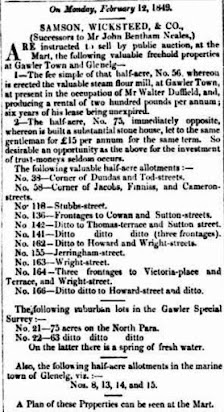
On Monday, February 12, 1849.

SAMSON, WICKSTEED, & CO.,

(Successors to Mr John Bentham Neales,)

ARE instructed to sell by public auction, at the Mart, the following valuable freehold properties at Gawler Town and Glenelg—

1—The fee simple of that half-acre, No. 56. whereon is erected the valuable steam flour mill, at Gawler Town, at present in the occupation of Mr Walter Duffield, and, producing a rental of two hundred pounds per annum; six years of his lease being unexpired.

2— That half-acre, No. 75, immediately opposite, whereon is built a substantial stone house, let to the same gentleman for £15 per annum for the same term. So desirable an opportunity as the above for the investment of trust-moneys seldom occurs.

The following valuable half-acre allotments : —

No. 33 — Corner of Dundas and Tod-streets.

No- 58_Comer of Jacobs, Finniss, and Cameron streets.

No- 118-Stubbs-street.

No. 136— Frontages to Cowan and Sutton-streets.

No 142 — Ditto to Thomas-terrace and Sutton street.

No. 141 — Ditto ditto ditto (three frontages).

No. 162— Ditto to Howard and Wright-streets.

No. 155 — Jerringham-street.

No. 163— Wright-street.

No. 164— Three frontages to Victoria-place and Terrace, and Wright-street.

No. 166— Ditto ditto to Howard-street and ditto.

The following suburban lots in the Gawler Special Survey: —

No 21—75 acres on the North Para.

No. 22— 63 ditto ditto ditto

On the latter there is a spring of fresh water.

-------

Also, the following half-acre allotments in the marine town of Glenelg, viz. : —

Nos. 8, 13, 14, and 15.

A. Plan of these Properties can be seen at the Mart.

Source: 1849 'Advertising', South Australian Register, (17 January 1849), p. 2., http://nla.gov.au/nla.news-article50247614

Sunday, 17 November 2019

Gawler Gas Works - Hidden Secrets


Gawler Gas Works

10 Seventh Street, Gawler.


[Begin Transcript]  In 1868, The Provincial Gas Company was formed to be direct competition to the South Australian Gas Company. The company’s foundation members included local Gawler businesses men James Martin and Sir Walter Duffield (CORRECTION - Walter Duffield was never knighted.). The Provincial Gas Company planned to build three gas works, one in Strathalbyn, one in Kapunda and one in Gawler.
 Parliament granted incorporation of the company in 1869, with equipment ordered from England the same year.

The Gawler Gas Works were built on 7th street, Gawler. Its fires were lit on the 10th of September 1869 with gas commencing through lines from the 14th of October 1869.
 Gawler Council did not wish to outlay money towards lamp lights within the town. It took until 1879, with the donation of a lamp for the northern end of Murray Street, from the aptly named H.E. Bright Junior for Gawler to get its first lamp. The next lamp was situated at the corner of Murray Street and Calton Road, and again was a donation, this time from James Martin. G.M. Hawkes donated a lamp for the southern intersection of Murray Street and Bridge Street.

 A man was employed in Gawler to light and extinguish the lamps. He rode a bicycle with a ladder on his shoulder. Gawler Council refused to light the gas lamps for 6 nights before, and six nights after a full moon. It also demanded all lamps to be extinguished from 10:30 pm to save money.
From 1866 until 1897 Gawler’s lamplighter was Mr Creyghton. Creyghton was replaced in 1897 after a lamp exploded, and he could not explain to the council how it occurred.  Mr Coward started as lamplight in 1898 earning 2 pounds, two shillings and 6d per month for his service. Coward served as a lamplighter in Gawler until 1909. The combined position of Nightman and Lamplighter was advertised in Gawler that same year.

 The new lamplighter D Wells faced considerable opposition from Council and was accused of not doing his job properly, with many councillors wanting the position refilled. Councillor Thorrup opposed stating that, the new lamplighter had not received much training from the previous man employed and needed more time to improve. Wells quit the position in March 1910.

Gawler South appointed its own lamplighter from 1907, Mr Michael Regan. In 1908 the position went to H. Masters.
Electricity generation came to Gawler on the 16th of June 1912. Mayor Reibech flicked the switch to turn on the new electric streetlights at the official opening on the 16th of August 1912.
The Gawler Gas Works continued production, supplying gas in the region, but with the installation of electricity in the town, the demand for gas dropped. The outbreak of World War One added further problems to the gasworks, making the supply of machinery and coal from NSW harder to come by. The Gawler Gas Works officially closed on 30th of November 1917.

  After many years of being empty, the site of the former gas works became a racing stable, with a house built on the property as well. The house was demolished in 2017.
 In 2018 the site has been made available for sale, with real estate agents, McGees property stating on their website about the site:
Approval for a modern, single-storey medical centre of 543 square metres (approx.), 51 car parks and a separate administration building of 390 sqm (approx.)

The rear former gasworks is protected under heritage laws, and can be modified for adaptive use, but must be preserved in future plans. [end transcript].

Researched, written, compiled, filmed and edited by Allen Tiller. [© 2019 – Hidden Secrets]


My thank to McGees Property: https://www.adl.mcgees.com.au/

Gawler History Team: www.gawlerhistory.com